
First Amendment Friday
April 3, 2026
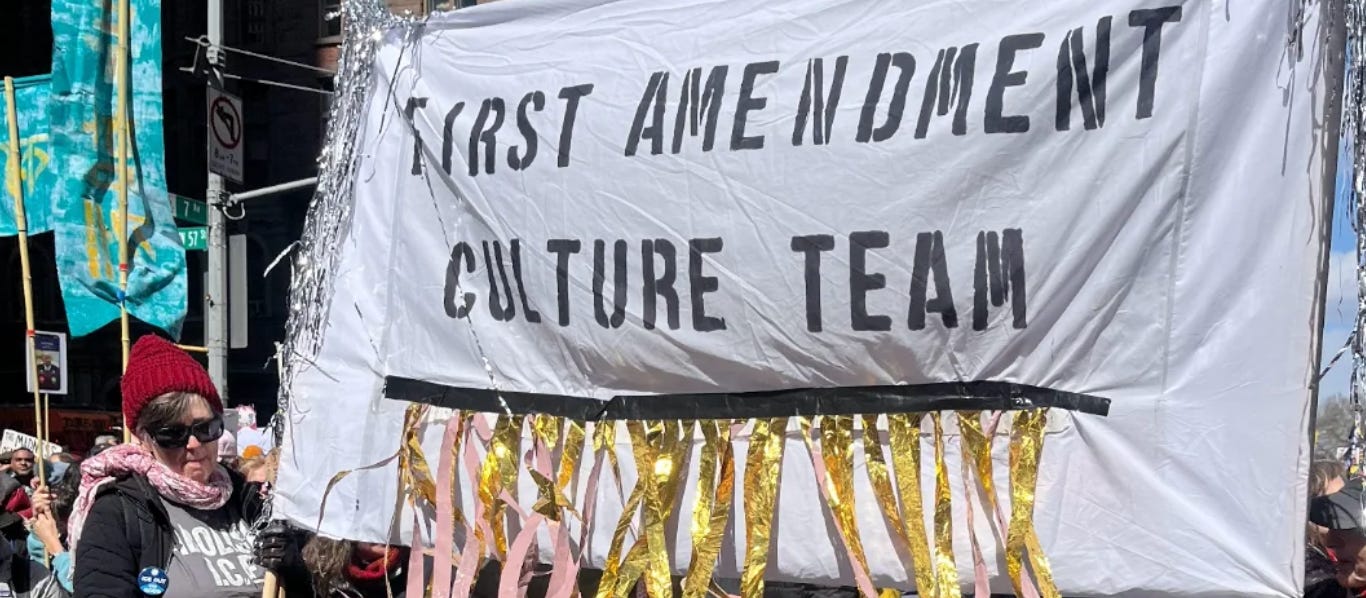
The First Amendment in the Streets
On Saturday, March 28, an estimated 8 million people participated in “No Kings” rallies across the country — roughly 3,300 events in all 50 states, with nearly 40 international events under the parallel banner “No Tyrants.” If the numbers hold, it would make Saturday’s mobilization the second-largest single-day protest in American history, behind only the 1970 Earth Day demonstrations. This was the third iteration of the No Kings movement, which drew an estimated 5 million in June 2025 and 7 million in October.
The First Amendment was not incidental to Saturday’s event. It was in may ways the subject. The NYPD reported that tens of thousands marched across all five boroughs without a single protest-related arrest, describing it as a demonstration of New Yorkers “peacefully exercising their First Amendment rights.” CBS News In Chicago, ACLU Illinois staff on the ground described the gathering explicitly as an affirmation of the First Amendment and the right to protest. WTTW Chicago In Rocky Ford, Colorado, one woman stood alone in front of a bank holding a sign reading “Protect the U.S. Constitution.” “I’m just exercising my First Amendment rights,” she said, as others gradually joined her. The Colorado Sun
The geographic breadth of the protests was notable. Organizers reported that almost half of all events took place in Republican-leaning areas. Texas, Florida, and Ohio each had over 100 events scheduled. States like Idaho, Wyoming, and Utah had demonstrations in the double digits, and one of the most remote gatherings took place in Kotzebue, Alaska. CNN
The White House dismissed the demonstrations as “Trump Derangement Therapy Sessions.” As of Sunday morning, the president had not commented. Yahoo! Counter-protesters in Dallas included pardoned January 6 figures Stewart Rhodes and Enrique Tarrio.
The movement’s name is constitutional in its origins. The founders’ rejection of monarchy — the principle that no individual holds power above the law or outside democratic accountability — is the foundational argument of the First Amendment itself. The right to assemble, to petition, to speak against government overreach exists precisely because the framers understood that democratic systems require active, public dissent to survive.
Saturday was evidence that a substantial portion of the country understands that.
What Gets Erased When the Grants Stop
Last week, Reveal from the Center for Investigative Reporting aired an episode worth your time: The Art Trump Doesn’t Want and the Artists Left Behind. Reporter Jonathan Jones drove Interstate 65 through Tennessee and Alabama, a year after the Trump administration abruptly canceled more than a thousand grants from the National Endowment for the Arts and the National Endowment for the Humanities totaling over $100 million.
The cancellations weren’t random. Court testimony from a DOGE staffer named Justin Fox revealed that grant descriptions were run through OpenAI’s ChatGPT, flagged for keywords including “diversity,” “equity,” “inclusion,” and “LGBTQ.” An indigenous language preservation project was classified as wasteful spending. A documentary about violence against Jewish women during the Holocaust was deemed impermissible because, in Fox’s words, focusing on “females during the Holocaust” was “inherently discriminatory.”

Jones visits Studio by the Tracks in Irondale, Alabama — a community art studio for adults on the autism spectrum — which lost the remaining two years of a $95,000 grant after receiving the first installment. He meets the Fort Negley Descendants Project in Nashville, mid-excavation of a Black Civil War-era neighborhood buried under an interstate, whose NEH grant was pulled with an email that read: “Please stop. You’re done.” He visits the Alabama Humanities Alliance, whose director now works out of a library corner because he couldn’t afford to keep the office after losing NEH funding.
The budgets of the NEA and NEH haven’t actually been cut — they remain roughly the same. What’s changed is who gets the money and what it can be used for. Approximately $34 million from the two endowments is being directed toward the president’s National Garden of American Heroes — 200 sculptures chosen from a pre-approved list. Rep. Chellie Pingree, top Democrat on the House Appropriations Subcommittee overseeing arts funding, called it “extremely dangerous territory.”
The episode ends in a library in Athens, Alabama, where a federally supported Smithsonian traveling exhibit celebrating local stories sits down the hall from shelves where books about transgender people have been relocated under new state rules, and where the head librarian lies awake, wondering whose story she won’t be able to tell next.
The Algorithm Is Not a Newspaper
David French, writing in the New York Times recently, raises legitimate First Amendment concerns about two recent jury verdicts against Meta — $375 million in New Mexico for enabling child sexual exploitation, and $6 million in California for addictive design features. His caution about constitutional overreach deserves a serious response. But his central premise doesn’t hold.
“A social media site isn’t a bottle of alcohol or a cigarette,” French writes. “It’s not delivering a drug. It’s delivering speech.” To support this, he cites Justice Kagan’s 2024 Moody v. NetChoice opinion, which compared algorithmic curation to a newspaper editor’s front page decisions — protected expressive activity.
The comparison breaks down on the facts. A newspaper editor makes choices based on newsworthiness, accountable to readers and competitors in an open market. Meta’s algorithm makes billions of individualized decisions per second, optimized for a single metric: engagement. Internal company documents, produced in litigation, confirmed that Meta’s own researchers identified a direct link between its recommendation systems and increased rates of anxiety, depression, and body image disorder in teenage girls — and that the company continued the practice anyway.
This is the evidentiary core on which the California case was built. The plaintiff’s argument wasn’t that speech harmed her. It was that a deliberately engineered behavioral system — infinite scroll, autoplay, notification frequency — was designed to maximize compulsive use in a population that included minors. French thinks the design/content distinction is a constitutional dodge. But product liability law has long distinguished between a substance and its delivery mechanism. That distinction is not alien to American law; it’s foundational to it.
We don't let cigarette manufacturers hide behind the argument that nicotine is a naturally occurring substance and that cigarettes are a delivery system. Similarly, algorithms choose what one sees based on what keeps you scrolling — and what keeps you scrolling, as internal documents from Meta have confirmed, is frequently outrage, anxiety, and compulsive comparison. The feed isn't curated like a newspaper. It's engineered like a slot machine, a delivery mechanism that keeps one hooked.
French also invokes the Founders’ marketplace of ideas as the framework at stake. But that marketplace assumed conditions that no longer exist. In 1791, the press was competitive, decentralized, and operated without algorithmic intermediaries. Today, two companies — Meta and Google — control the primary channels through which Americans encounter public information. That’s not a marketplace. It’s an infrastructure, and the question of who controls infrastructure, on what terms, and with what accountability has never been a First Amendment question alone.
The verdicts may well be modified or overturned on appeal. But the legal and constitutional framework French is defending was built for a different information environment. The question these cases force — at what point does engineered compulsion in minors constitute actionable harm regardless of the speech it delivers — is one the First Amendment, as currently interpreted, doesn’t yet have an answer for.
There's a further contradiction worth naming. When social media platforms face liability for user-generated content, they invoke Section 230 of the Communications Decency Act, which shields them from being treated as publishers — precisely because, they argue, they are neutral delivery platforms, not editorial decision-makers. But when their algorithmic curation is challenged, they claim First Amendment protection as editors exercising expressive judgment. They cannot be both. The platforms have spent thirty years arguing in court that they bear no publisher's responsibility for what moves through their systems, while simultaneously building recommendation engines that determine, at massive scale, what gets amplified and what disappears. Section 230 was written in 1996 for a nascent internet of bulletin boards and chat rooms. Extending that immunity to cover the deliberate behavioral engineering of a platform with three billion users is not what Congress intended, and several federal courts have begun to say so.
Trump’s Public Media Defunding Ruled Unconstitutional
On March 31, a federal judge delivered a significant First Amendment victory to public media, striking down a key provision of President Trump’s executive order targeting NPR and PBS as unconstitutional.
U.S. District of Columbia Judge Randolph Moss ruled that the core provision of Executive Order 14290, issued in May 2025 and titled “Ending Taxpayer Subsidization of Biased Media,” violated the First Amendment, declaring it unlawful and unenforceable, and permanently enjoining the government from implementing it. The order had directed federal agencies to terminate “any direct or indirect funding of NPR and PBS,” and set in motion a series of grant cancellations across the NEA, FEMA, and the Department of Education. NPR
The legal principle at stake was clear: the First Amendment right to free speech “does not tolerate viewpoint discrimination and retaliation of this type.” In his 62-page opinion, Moss wrote that the executive order was unconstitutional because it sought to punish NPR and PBS for speech the President dislikes, an explicit case of viewpoint discrimination. The ruling cited a 2024 Supreme Court precedent: the government may not cross the line of using “the power of the purse to punish or suppress disfavored expression.” Colorado Public Radio
The case was brought by NPR alongside three Colorado public radio stations (Aspen Public Radio, Colorado Public Radio, and KSUT) selected in part because their combined reach embodied the breadth of communities that public media serves. NPR
The ruling does not restore funding. Congress separately rescinded $1.1 billion in previously approved public media funding in July 2025, and the Corporation for Public Broadcasting has since gone out of business. But the ruling matters structurally: it establishes that a future Congress could resume public media funding, and that local stations retaining any federal support cannot be pressured on editorial content. AP
The Right to Stay Seated
The rules around enforcing students to recite the Pledge of Allegiance have been settled since 1943. In West Virginia State Board of Education v. Barnette, the Supreme Court ruled that compelling students to salute the flag or recite the Pledge of Allegiance violates the First Amendment. This is one of the Court’s most unambiguous free speech holdings. Justice Robert Jackson wrote that “no official can prescribe what shall be orthodox in politics, nationalism, religion, or other matters of opinion.” The case arose from Jehovah’s Witnesses being expelled for refusing to salute.
That didn’t protect Danielle Khalaf.
In January 2025, the 14-year-old Palestinian American quietly declined, on three separate days, to stand for the pledge at her Michigan high school in protest of U.S. support for Israel’s war in Gaza. Her teacher told her she was being disrespectful and said, “Since you live in this country and enjoy its freedom, if you don’t like it, you should go back to your country.” WRAL The ACLU of Michigan and the Arab American Civil Rights League filed a federal lawsuit, arguing the conduct violated Danielle’s First Amendment rights and created an atmosphere of intimidation that made other students fearful of exercising theirs. ACLU of Michigan
The case settled last week. The district agreed to provide First Amendment training to staff, and an insurance company paid $10,000 on behalf of the teacher. Anything in Danielle’s file suggesting her actions violated school policy will be removed. Compelled patriotism directed at a student with family ties to the conflict wasn’t a procedural slip; it’s targeted silencing. It’s also something I experienced in grade school many years ago.
They’re Coming for Dolly’s Books
A Louisville Courier-Journal opinion piece by Joseph Gerth put it plainly: Republicans in multiple states are moving to defund the Dolly Parton Imagination Library, a program that mails free, age-appropriate books monthly to children from birth through age five, and nobody on the defunding side has offered a coherent explanation for why.
The pattern is consistent. In Indiana, Governor Mike Braun eliminated the program from the state budget in 2025, after his predecessor had expanded it to reach every county in the state. IPB In Kentucky, a Republican state senator filed an amendment that would have prohibited state general fund dollars from going to the program at all. Kentucky’s funding was restored in a last-minute budget agreement this week, but the fight itself revealed the impulse. WKYT
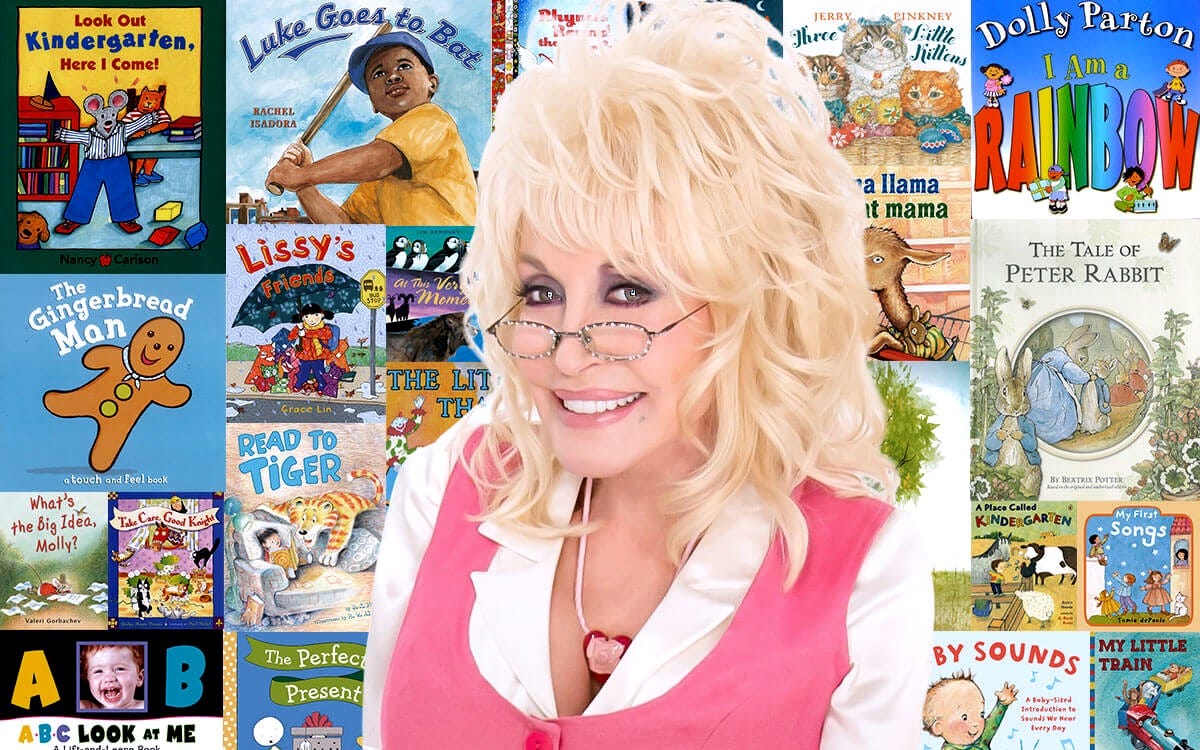
Gerth’s point is hard to argue with. The books aren’t controversial; they cover counting, colors, animal sounds, and friendship. The cost is negligible: roughly $1.51 per book. In Indiana, the program had been credited with pushing the state from 19th to 6th in national child literacy rankings. Rolling Stone
The First Amendment dimension here isn’t about a single lawsuit. It’s about the broader pattern of defunding the infrastructure of an informed citizenry, public media, public libraries, and early literacy programs, with no stated rationale beyond culture war signaling. Access to books in early childhood isn’t a partisan issue. Treating it as one tells you something. Gerth’s Column
Revising the Privacy Protection Act
The FBI raided Washington Post reporter Hannah Natanson’s Virginia home in January, seizing her devices as part of a leaked investigation involving a government contractor. The raid was legal — which is the problem.
The Privacy Protection Act of 1980 generally forbids the government from using search warrants to raid journalists’ homes or seize their equipment, according to Freedom of the Press Foundation. Still, it has a structural flaw that’s been exploited repeatedly. At least six times in recent years, prosecutors seeking warrants failed to disclose to judges that such searches are illegal under the Act. By the time a court figures that out, the damage is done: sources are burned, devices are gone, stories are killed.
Vermont Representative Becca Balint and Oregon Senator Ron Wyden introduced legislation last week to close those loopholes, requiring the government to affirmatively cite the Privacy Protection Act in any warrant application involving journalists’ materials — and to prove an exception applies. The bill would also establish mandatory judicial review within 48 hours of any emergency seizure, and create an exclusionary rule suppressing materials that are illegally seized; something the current law conspicuously lacks. Representative Balint, Senator Wyden
The chilling effect here isn’t hypothetical. A reporter who knows their home can be raided without a judge ever being told the raid is presumptively illegal is a reporter who thinks twice about what they write, who they call, and what they keep.
Acknowledgement
We are always grateful for the encouragement and suggestions of our colleagues and peers.
NEXT STEPS: TAKE ACTION
First Amendment Friday
F.A.C.T. invites all cultural institutions, artists, and activists to post First Amendment stories, graphics, calls to action, and advice to their audience every Friday. Join our campaign by signing up here. Feel free to use our digital assets here.
Public Practice
We are asking cultural venues in New York City (and across the USA) to prominently place our First Amendment poster in their public areas. Sign up to get your copy. We are also asking performance venues to share our curtain speech (or create your own).