
First Amendment Friday
April 10, 2026
The Talking Cure and the First Amendment
The Supreme Court’s 8-1 ruling in Chiles v. Salazar last week declared that Colorado’s ban on conversion therapy for minors, at least as applied to talk therapy, constitutes viewpoint discrimination subject to strict scrutiny under the First Amendment. Justice Ketanji Brown Jackson’s solo dissent offers a counterargument worth examining closely, not because it prevailed but because it illuminates a genuinely murky area of constitutional law: When does professional speech become protected speech? When does medical opinion become viewpoint?
The Legal Architecture
The majority opinion, written by Justice Gorsuch, builds on precedent established in National Institute of Family and Life Advocates v. Becerra (2018), where the Court set out a plain rule: “Professional speech” is not “a unique category that is exempt from ordinary First Amendment principles.” This 2018 ruling rejected California’s attempt to require crisis pregnancy centers to post notices about state-funded abortion services, framing compelled speech to professionals as triggering First Amendment concerns.
Chiles extends this logic. Gorsuch stressed that “the spoken word is perhaps the quintessential form of protected speech, which does not lose its protection simply because it can be described as therapy.” The Colorado law, which allows therapists to provide gender-affirming counseling while prohibiting efforts to change a minor’s sexual orientation or gender identity, “suppressed one side of a debate, while aiding the other,” in other words, textbook viewpoint discrimination.
The precedents Gorsuch marshals are formidable: Cohen v. California (1971), protecting a man’s profane anti-draft jacket; Holder v. Humanitarian Law Project (2010), on material support to designated terrorist organizations; Reed v. Town of Gilbert (2015), on content-based restrictions. Laws regulating speech based on “communicative content” are “presumptively unconstitutional,” triggering strict scrutiny.
Jackson’s Counter Framework
Justice Jackson opens her dissent with a century-old precedent that cuts the other way: “There is no right to practice medicine which is not subordinate to the police power of the States.” Lambert v. Yellowley (1926).
This is not an obscure citation. Lambert addressed Prohibition-era restrictions on physicians prescribing alcohol. The Supreme Court in 1926 upheld the regulation as a valid exercise of state police power over medical practice. Jackson argues that the same principle should govern here: “blocking Colorado from regulating speech uttered for purposes of providing medical treatment … opens a dangerous can of worms” and “threatens to impair States’ ability to regulate the provision of medical care in any respect.”
Jackson’s dissent also draws on Planned Parenthood v. Casey (1992), which upheld Pennsylvania’s informed consent requirements for abortion, framing medical speech regulations as “speech incident to conduct.” The distinction matters: if talk therapy is conduct that incidentally involves speech, the state can regulate it under rational basis review. If it’s “speech as speech,” strict scrutiny applies, and strict scrutiny is almost always fatal. An analogy to “speech incident to conduct” might be a physician writing a prescription - while the prescription involves putting words on paper, that’s not an exercise of free speech; it’s a state-regulated action.
The Curious Problem of “Standard of Care”
Both sides invoke “standard of care,” but the concept operates differently in malpractice law than in regulatory prohibition.
In mental health practice, there is no universally agreed-upon consensus on what constitutes “evidence” in evidence-based practice. New York State’s Office of Professions acknowledges this directly: case-based vs. experimental studies; evidence from efficacy trials as opposed to clinical experience and expertise; process therapies which emphasize practitioner competency, skills, qualities, and therapeutic alliance vs. specific techniques—all qualify as legitimate forms of evidence.
Currently, there are more than 450 schools of psychotherapy in existence. The regulatory question then becomes: How can the public be protected against harmful or useless treatments? Who separates the competent therapist from the incompetent?
The conventional answer is licensing boards, malpractice liability, and professional consensus. But professional consensus shifts. Gorsuch’s majority opinion makes precisely this point: “Not long ago, many medical experts and organizations, including the American Psychiatric Association, considered homosexuality a mental disorder.” The Court challenged the view Colorado advanced by saying that Colorado could have constitutionally enforced therapy aimed at “curing” homosexuality when that was the professional consensus, and now it wants to constitutionally prohibit the opposite practice.
The Malpractice Distinction
The majority and dissent also diverge on how malpractice law operates. Traditional malpractice allows patients to consent to treatments that depart from prevailing standards, such as experimental procedures, off-label uses, and alternative approaches. Colorado’s law, by contrast, does not allow clients to consent to practices that depart from the prevailing standard of care, while malpractice law sometimes does.
This distinction matters more than it might appear. Malpractice is retrospective: a patient harmed by substandard care can seek remedy after the fact. Colorado’s proposed ban is prospective and categorical: certain conversations are prohibited regardless of patient preference, informed consent, or outcome. One is a check on professional deviation; the other is a pre-commitment to orthodoxy.
The Grey Zone: Religion, Culture, and Therapeutic Modality
The case becomes more interesting and more philosophically fraught when you consider the actual practice of therapy across cultural and religious contexts.
Kaley Chiles, the plaintiff, describes her practice as “faith-informed counseling.” The word “religion” does not even appear in Gorsuch’s opinion (it’s formally a Free Speech Clause case), but religious conviction underlies the human drama. Chiles believes people flourish when they live consistently with “God’s design,” and some clients seek her out precisely because they want counseling consonant with those convictions.
This raises a question the Court doesn’t fully address: What happens when a patient’s paradigmatic universe includes beliefs that mainstream medicine rejects?
Consider a patient who believes in demonic possession. A chaplain working in psychiatric hospitals reports that requests for exorcism are common, and that pastoral counseling techniques often help, not by validating the belief in demons but by working within the patient’s framework. The chaplain’s approach: “Just as spiritual assessment does not require us to believe in the existence of a patient’s legendarium, neither does it require us to debunk it or explain it away. Relaxing our focus on reality/unreality questions leaves room for the patient’s theology to remain true.” Harvard Divinity Bulletin
The United States Conference of Catholic Bishops (USCCB) describes exorcism as “part of the regular pastoral care of souls,” and multiple universities now offer formal training in the practice. The Pontifical Athenaeum Regina Apostolorum in Rome runs a course examining the anthropological, phenomenological, social, theological, liturgical, canonical, pastoral, spiritual, medical, neuroscientific, pharmacological, symbolic, criminological, legal, and juridical dimensions related to the ministry of exorcism.
Is exorcism therapy? If a licensed counselor integrates prayer, scripture, and spiritual direction into their practice, as pastoral counselors routinely do, when does their speech cross from protected religious expression to regulable medical treatment? Clergy who perform pastoral counseling as part of their ministry cannot legally diagnose mental health conditions or prescribe medications, but they can counsel patients experiencing spiritual crises in ways that overlap substantially with clinical practice.
Colorado’s conversion therapy ban explicitly exempted therapists “engaged in the practice of religious ministry.” But this carve-out created its own problems: it suggests the state recognizes the speech-conduct distinction operates differently in religious contexts, even when the underlying therapeutic techniques might be identical.
With over 450 distinct psychotherapy modalities in existence—psychodynamic, cognitive-behavioral, humanistic, existential, Jungian, Gestalt, EMDR, somatic experiencing, dialectical behavioral, narrative, solution-focused, and countless variations - the question of what constitutes legitimate therapy versus harmful pseudoscience is genuinely contested.
Research suggests that “non-specific factors, such as therapist empathy and the working alliance,” may be more predictive of therapeutic outcomes than the specific modality employed. The so-called “Dodo Bird Verdict,” the finding that all psychotherapies produce roughly equivalent outcomes, remains controversial but has substantial empirical support.
Approximately 10% of patients experience worsening of symptoms following long-term treatment in psychotherapy, though it’s unclear what proportion is due to the treatment itself versus other factors. Unlike pharmacology, the potential negative effects of psychological treatments remain under-researched.
If efficacy is uncertain, harm is difficult to measure, and the therapeutic relationship matters more than the specific technique, how does a state draw defensible regulatory lines?
The Informational Marketplace vs. the Therapeutic Relationship
The First Amendment’s “marketplace of ideas” theory assumes that truth emerges from the competition of viewpoints in public discourse. This metaphor has obvious limits when transplanted to the consulting room.
The therapeutic relationship is fiduciary, not dialectical. The patient is not a consumer choosing among competing products in a marketplace; they are vulnerable, often in crisis, and dependent on the professional’s expertise and care. The asymmetry of knowledge and power is constitutive of the relationship.
Professional speech, as one Yale Law Journal essay argued, involves “fiduciary duties to their clients; such duties between speakers do not exist elsewhere in First Amendment doctrine.”
Yet the alternative, allowing states to determine what viewpoints therapists may express to patients, has its own dangers. The majority notes that its ruling applies symmetrically: a hypothetical red-state law banning gender-affirming therapy would fail for the same reasons. Justice Kagan’s concurrence emphasizes this: “Consider a hypothetical law that is the mirror image of Colorado’s. Instead of barring talk therapy designed to change a minor’s sexual orientation or gender identity, this law bars therapy affirming those things. As Ms. Chiles readily acknowledges, the First Amendment would apply in the identical way.” In principle, allowing conversion therapy makes the case for legalizing gender-affirming therapy in States that try to deny it.
The Texas Parallel Revisited
The abortion comparison illuminates the asymmetry differently. In Texas, abortion-related speech isn’t formally prohibited, but the legal architecture around abortion creates massive chilling effects. Physicians don’t know what conversations might expose them to criminal liability. The Texas Medical Association has objected that vague laws and life-in-prison penalties interfere with patient-physician relationships and prevent necessary care.
But there’s a more direct parallel now. Just weeks before Chiles was decided, Texas Attorney General Ken Paxton issued a legal opinion declaring that the state’s existing ban on gender-affirming medical care for minors also applies to mental health providers. Under his interpretation, therapists who affirm a transgender youth’s gender identity are “facilitating” illegal treatment and committing child abuse. They could lose their licenses, be barred from Medicaid reimbursement, and face criminal penalties. Paxton’s office has already used this framework to sue doctors and revoke licenses.
This is precisely the “mirror image” scenario Justice Kagan anticipated in her concurrence. A law banning talk therapy that affirms a minor’s gender identity raises identical First Amendment concerns as Colorado’s law banning talk therapy that attempts to change it. Both restrict what therapists can say based on viewpoint. Both should, under the logic of Chiles, trigger strict scrutiny.
The National Association of Social Workers in Texas has advised therapists that their counseling remains protected speech under the First Amendment. But reports indicate some therapists have already dropped transgender patients out of fear by ”complying in advance.” The chilling effect operates regardless of what courts eventually decide.
So we now have two states using opposite regulatory strategies against the same First Amendment framework. Colorado says: you cannot counsel patients toward one view of their identity. Texas says: you cannot counsel patients toward the other view. Chiles suggests both restrictions are constitutionally suspect, but only Colorado’s law was before the Court. Texas continues enforcing its interpretation while therapists navigate legal uncertainty.
The deeper problem is what this reveals about professional regulation as a site of ideological contestation. Both states claim to be protecting minors. Both invoke professional consensus, although they invoke opposite consensuses. Both subordinate the therapeutic relationship to the legal architecture surrounding it. The patient’s well-being becomes secondary to which viewpoint the state has chosen to suppress.
Jackson’s dissent warns that the ruling could be “ushering in an era of unprofessional and unsafe medical care” where some forms of treatment are effectively free from regulation. She mentions informed consent regulations specifically—requirements that medical practitioners ensure patients understand risks before undergoing treatment. If talk therapy is protected speech rather than regulable medical conduct, can states still mandate informed consent disclosures? Can licensing boards discipline therapists whose advice causes harm if that advice is constitutionally protected expression?
The American Psychological Association has raised alarms about precisely this implication. As one UCSF psychiatrist put it: “The court majority has, in effect, opened the door to protecting any harmful or toxic form of persuasion or therapy on these grounds.”
What the First Amendment Embraces
The dogmatic approach to freedom of expression has real appeal. It prevents states from declaring winners in ideological disputes by regulatory fiat. It protects dissenting views against majoritarian orthodoxy. It recognizes that professional consensus has been catastrophically wrong before and will be again.
But the First Amendment also recognizes contexts that transform speech. You cannot commit fraud and claim First Amendment protection. You cannot threaten violence. You cannot practice medicine without a license, even if your “practice” consists entirely of talking.
The question Chiles leaves unresolved: if the state cannot ban viewpoints in the therapy room, can it ban therapies that consist entirely of viewpoints? If professional licensing cannot restrict what a therapist says, what does licensing actually regulate?
The Work Ahead
Chiles remands the case to the Tenth Circuit to apply strict scrutiny. Given the medical consensus on conversion therapy’s harms, Colorado may yet prevail, or craft a more viewpoint-neutral regulation that survives review.
But the larger questions persist. How do we regulate professions whose practice consists primarily of speech? How do we protect vulnerable patients while respecting their autonomy—including their right to seek practitioners whose values align with their own?
Justice Jackson’s dissent articulates something important: “Chiles is not speaking in the ether; she is providing therapy to minors as a licensed healthcare professional.” The First Amendment is not a get-out-of-regulation-free card for everything done with words.
American Museums are Erasing History
Two of America’s most significant cultural institutions, the Smithsonian and the U.S. Holocaust Memorial Museum, are now removing, altering, or suppressing content that centers the history of racism, democratic fragility, and the experiences of marginalized communities. In both cases, the changes are happening without direct orders from the White House. The institutions are doing the work themselves.
THE SMITHSONIAN
On December 18, 2025, the White House escalated its campaign against the Smithsonian, threatening to withhold federal funding unless the institution submits its exhibition content, curatorial processes, and staff information to executive review.
The letter states that Smithsonian funds are “only available for use in a manner consistent with Executive Order 14253, ‘Restoring Truth and Sanity to American History.’” The Smithsonian receives roughly two-thirds of its budget from federal appropriations, a dependency the administration is now using as leverage.
The executive order explicitly names the Smithsonian American Art Museum’s “The Shape of Power” exhibition for stating that “societies including the United States have used race to establish and maintain systems of power, privilege, and disenfranchisement. This is not a fringe claim. It is mainstream historical scholarship. But under this framework, it becomes evidence of “divisive ideology.”
The order directs officials to ensure appropriations “prohibit expenditure on exhibits or programs that degrade shared American values, divide Americans based on race, or promote programs or ideologies inconsistent with Federal law and policy.”
Read that again: exhibitions that discuss how race has operated in American history are reframed as exhibits that “divide Americans based on race.
The White House has demanded complete digital files of all wall text and exhibition labels currently on view, draft concepts for upcoming programming, organizational charts and curatorial manuals, and names, titles, CVs, and contact information for staff at eight museums, including the National Museum of African American History and Culture and the National Museum of the American Indian, for its review. The letter insists museums convey “a positive view of American history, one which is justifiably proud of our country’s accomplishments.” Accuracy is not a consideration.
In January 2026, the Smithsonian handed over the requested materials, including digital photographs of labels, placards, and other text on public display in several galleries.
The National Portrait Gallery removed wall text next to Trump’s portrait that mentioned his two impeachments “on charges of abuse of power and incitement of insurrection.” NPR Trump is now the only president in the gallery whose display does not include extended biographical text. The portraits of Andrew Johnson and Bill Clinton still mention their impeachments.
In July 2025, artist Amy Sherald, who painted Michelle Obama’s official portrait, canceled her major exhibition “American Sublime” at the National Portrait Gallery, citing censorship. The museum had raised concerns about her painting “Trans Forming Liberty,” which depicts the Statue of Liberty modeled after a Black transgender artist. CNN

Sherald said Bunch proposed replacing the painting with a video of people discussing transgender issues—including people sharing anti-transgender views. She refused. “I cannot in good conscience comply with a culture of censorship,” Sherald said, “especially when it targets vulnerable communities.” Sherald would have been the first contemporary Black artist to have a solo exhibition at the National Portrait Gallery. Artnet News
Six of the nine public regents’ terms on the Smithsonian board end this year, allowing Trump to expand his influence before the midterms.
THE HOLOCAUST MUSEUM
The U.S. Holocaust Memorial Museum has not faced the same public pressure campaign as the Smithsonian. And yet, according to a Politico investigation published this week, it has been quietly removing content and canceling programming since 2025—preemptively, without being asked.
Two former employees told Politico they believed the museum was altering its content to avoid drawing negative attention from the Trump administration. One said: “It seems like they were trying to proactively fall in line as to not then be forced to change.”
Sometime after August 29, 2025, the museum removed a webpage called “Teaching Materials on Nazism and Jim Crow.” That page provided lesson plans about connections between American de jure racism and Nazi racial policy, including resources about African American soldiers during World War II and Afro-Germans during the Holocaust.
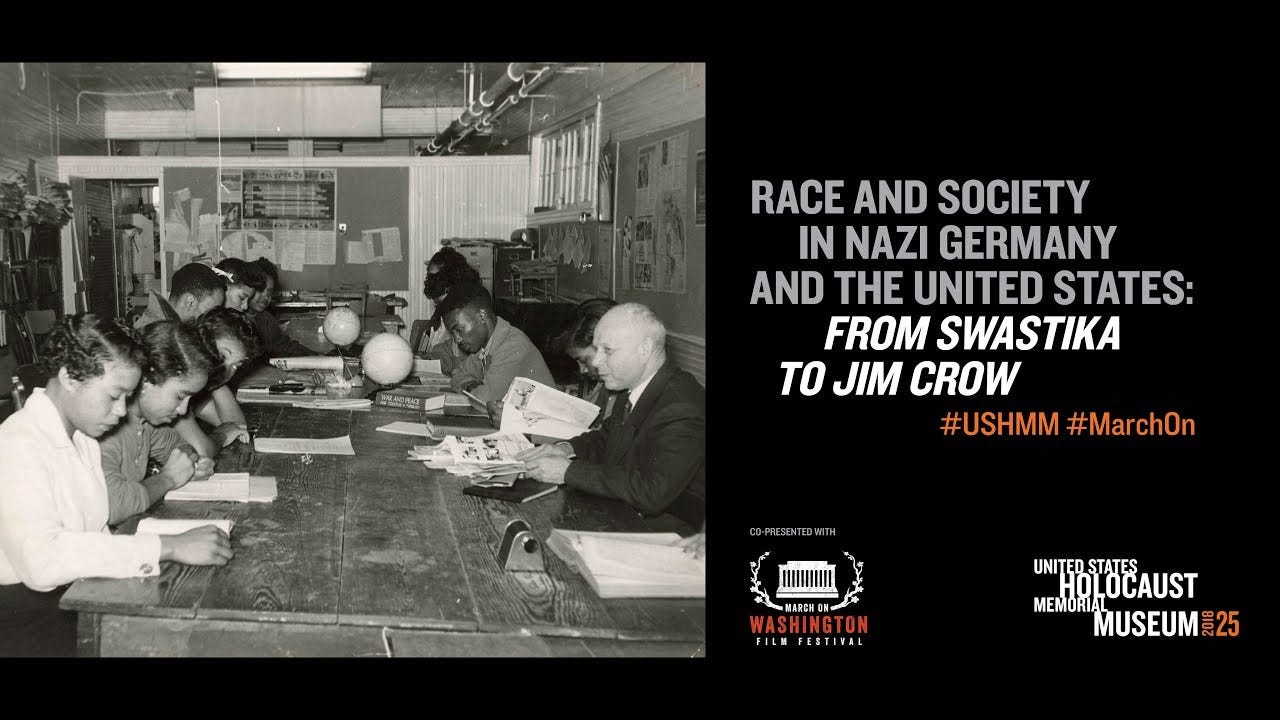
A 2018 video featuring a Holocaust survivor in conversation with a woman whose father was lynched in Alabama has been unlisted from the museum’s YouTube page.
A civic education workshop was renamed from “Fragility of Democracy and the Rise of the Nazis” to “Before the Holocaust: German Society and the Nazi Rise to Power.” Internal emails cited concerns about how the word “fragility” might be perceived “in the current climate.” The program was then canceled entirely in July 2025.
Museum staff told professors the cancellation was due to “limited federal funds and a difficult fundraising environment”—yet the museum’s total assets surpassed $1 billion that year, with a $52.4 million increase in net assets attributed to strong donor support. Yahoo!
The museum emphasized in a statement that “The Trump administration has not requested any changes to the Museum’s content or programming.” That’s precisely the point. The administration didn’t have to ask.
Trump had already fired Biden-appointed board members, including Doug Emhoff, Ron Klain, and Susan Rice, before their terms expired, an unprecedented move. Emhoff responded: “Holocaust remembrance and education should never be politicized. To turn one of the worst atrocities in history into a wedge issue is dangerous—and it dishonors the memory of six million Jews murdered by Nazis that this museum was created to preserve.” NPR
In March 2026, Trump installed Republican lobbyist Jeffrey Miller as chairman, replacing Stuart Eizenstat, a museum co-founder.
THE PATTERN: DEI SUPPRESSION BY ANOTHER NAME
These are not isolated incidents. They are part of a coordinated campaign to remove content that centers the experiences of Black, Indigenous, and other communities of color as historical subjects rather than background figures in a celebratory national narrative.
The Holocaust Museum’s removed materials drew direct lines between American racial terror and the Nazi regime’s policies. This is documented scholarship. The Nazis studied American segregation laws. They cited American eugenics. The connections between Jim Crow and Nuremberg are part of the historical record.
But under the current framework, acknowledging those connections becomes unacceptable because it complicates the mandated narrative that America has been “among the greatest forces for good in the history of the world.”
The Smithsonian’s National Museum of African American History and Culture is on the target list. So is the National Museum of the American Indian. The National Museum of African American History and Culture was criticized by the administration for giving too much space to the brutal reality of slavery, rather than the “success” and “brightness” of America. The Daily Beast
Trump himself posted on social media that the Smithsonian was “out of control” and too focused on “how horrible our country is, how bad slavery was and how unaccomplished the downtrodden have been—nothing about success, nothing about brightness, nothing about the future.”
ANTICIPATORY OBEDIENCE
Historian Timothy Snyder’s first lesson in On Tyranny is: “Do not obey in advance.” He writes, “Most of the power of authoritarianism is freely given. In times like these, individuals think ahead about what a more repressive government will want, and then offer themselves without being asked. A citizen who adapts in this way is teaching power what it can do.” Timothysnyder
Snyder traces the pattern to Austria in 1938: “The anticipatory obedience of Austrians in March 1938 taught the high Nazi leadership what was possible.” Literary Hub
This is what makes preemptive compliance so dangerous: it reveals what can be done, normalizes submission, and accelerates the erosion of liberty—all before anyone in power has to lift a finger.
When the Holocaust Museum removes its own content about American racism’s historical relationship to Nazi racial law, it isn’t just failing its mission. It is becoming the very case study it was built to prevent.
This is not about “divisive narratives” or “DEI ideology.” It is about whether American history can include the full humanity of people who were enslaved, lynched, segregated, and systematically excluded—and whether that history can be connected to global patterns of racial violence and democratic collapse.
The removed content centered Black lives, Black soldiers, Black victims of American terror, and Black-Jewish dialogue about shared histories of persecution. The canceled programming explored how democracies fail. The suppressed artwork depicted a Black transgender woman as the Statue of Liberty.
The question is whether institutions built to preserve and present the full complexity of American history—and to warn against the conditions that produce atrocity—will do so. Or whether they will quietly remove the parts that make power uncomfortable, and call it a “planned update.”
When the Battle Leaves the Ring
Two weeks ago, the Floyd Abrams Institute for Freedom of Expression at Yale Law School filed an amicus brief in Drake’s defamation appeal against Universal Music Group that opened with a striking analogy: A boxer who challenges the world champion, gets knocked out on live television, and then sues for battery will lose, because consent is a complete defense to an intentional tort.
The backstory is familiar: in 2024, Kendrick Lamar released "Not Like Us," a diss track that, among other things, called Drake a "certified pedophile." Drake filed suit not against Lamar but against the record label distributing Lamar’s music, arguing that UMG promoted a song containing allegations it knew were false — an attempt to frame UMG's distribution and marketing apparatus as the defaming party, rather than the artist. Alhlaw
The amicus brief argues that Drake, like a boxer facing an opponent, consented to battle. He challenged Kendrick Lamar. Drake explicitly taunted him in raps like “Family Matters,” alleging abusive behavior. When Lamar delivered a blow in response, ”Say, Drake, I hear you like ‘em young” Drake filed suit.
The legal question is narrow: Did Drake consent to the very defamation he now claims injured him?
The cultural question is ancient. Every society that values free discourse must solve the same problem: How do you permit extreme argument, the kind that attacks character, questions legitimacy, wounds reputation, without that argument escalating into violence that fractures the social order?
The solutions are old and focus on a framework where public engagement equals consent. The Greek agora. The Roman Forum. Trial by combat. The formal duel. The rules of these spaces share a common logic: opponents enter voluntarily, weapons are specified, boundaries are enforced, and what happens inside stays inside.
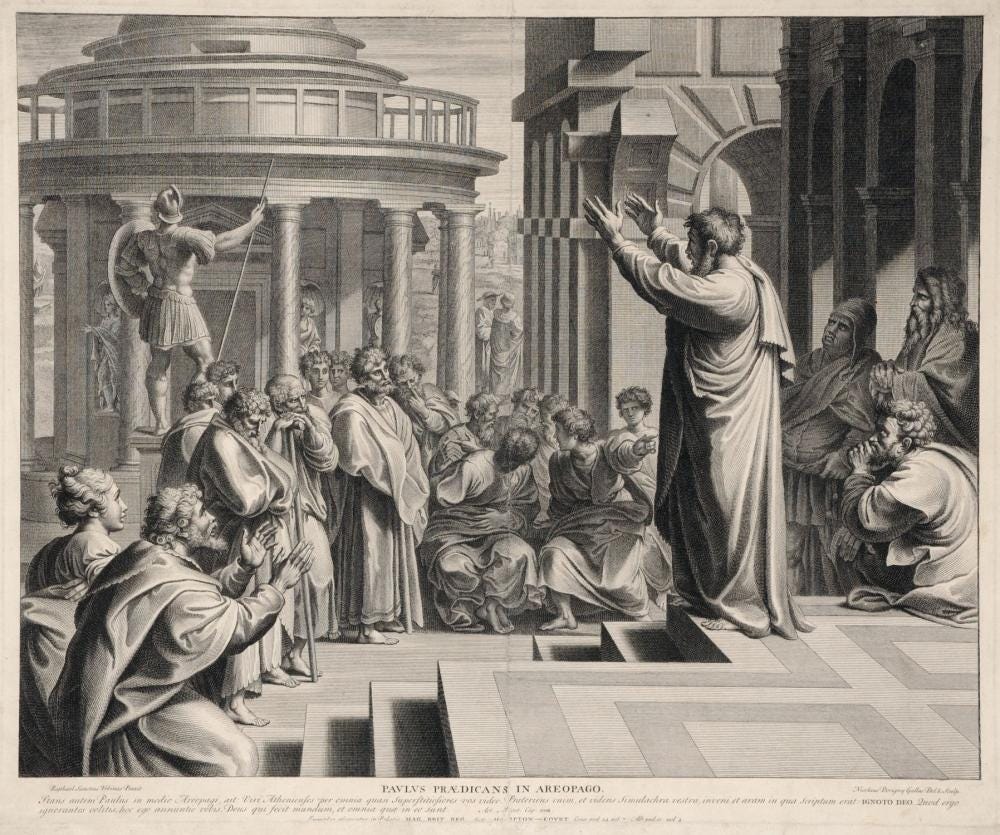
Much of our Western artistic tradition examines what happens when the boundaries of public debate are violated. Greek tragedy itself emerged from this tension; Aeschylus’s Oresteia tracks the transformation from blood feud to courtroom, Athena establishing the Areopagus precisely to end the cycle of retributive violence that speech alone could not contain.
Shakespeare returns to the problem obsessively: Richard II begins with the failure of ritual combat, Bolingbroke and Mowbray’s duel is interrupted by the king, the containment fails, and civil war follows. Hamlet delays action while words multiply; the play-within-a-play shows the failure of speech to keep violence from shattering the social contract. Othello shows language itself as a weapon; Iago needs no sword, only insinuation.
The operatic tradition, funded by monarchs, inherits the question. Mozart’s Marriage of Figaro stages class warfare as a combat of wits, the Count’s power checked by servants who out-argue him. The formal structures of opera—recitative giving way to aria, ensemble building to finale, mirror the legal structures of contained conflict: rules of engagement, escalation within bounds, resolution. In Mozart's La clemenza di Tito, the emperor Titus keeps it in the ring by refusing to fight. The entire drama turns on Emperor Titus's choice not to punish his adversary. His clemency is not weakness but a deliberate assertion that the sovereign's power to forgive is greater than the power to destroy. Words are enough, and the opera stages the radical proposition that the state's legitimacy rests on its capacity for restraint.
American art restages these European forms in a democratic key. Hamilton literalizes the problem: Burr and Hamilton step outside the law to settle what the law could not contain, and the tragedy is precisely that the courtroom, the cabinet, the newspaper editorial could not hold the conflict. West Side Story translates Romeo and Juliet into gang territory where the “rumble” is the ring, and crossing from insult to knife-fight marks the boundary where justice is no longer the province of civil society.
Hip-hop’s evolution from park jams to battle rap to diss tracks recapitulates this history: formalized competition as an alternative to street violence, microphones replacing weapons, reputation replacing territory. Battle rap has rules: rhyme, originality, escalation within genre conventions. Participants enter knowing they will be attacked. The attacks are understood as performance.
The “ring” used to be a neighborhood lot or a social club, and the audience was the judge. But the “ring” has morphed into a massive algorithmically driven cyberspace where the audience no longer sees each other’s faces. Now Drake seeks a remedy outside the ring. He has asked the courts to treat Lamar’s lyrics not as ritualized combat but as actionable defamation - false statements of fact that caused real harm.
The legal system’s response invokes a doctrine with a Latin name: volenti non fit injuria. To a willing person, no injury is done. You cannot sue for battery after consenting to a boxing match (or a rap battle). You cannot claim defamation after inviting the attack.
But consent has limits. A boxer consents to punches, not to being struck with an iron bar. The question becomes: Did Lamar’s accusations exceed the scope of what Drake agreed to? Are accusations of pedophilia, even in a diss track, outside the rules of engagement?
The court will decide. But the deeper issue is the one that connects the agora to the courtroom: legal language is how we draw the ring. It defines what combat is permitted, what weapons are allowed, and what happens when the bell rings.
The First Amendment protects extreme speech because democracy requires it. But protection is not the same as immunity from consequence. The ring contains the violence precisely by defining its limits. Drake stepped in. He threw punches. He took punches. Now he wants the referee to call a foul. The law will decide whether he’s right or whether he simply lost the fight.
A Grandmother, a Phallus, and the First Amendment
In Fairhope, Alabama, a town founded in the 1890s as a utopian experiment by independent thinkers, artists, and writers, a 62-year-old grandmother and ASL interpreter named Renea Gamble faces trial on April 15th for wearing an inflatable penis costume at a No Kings protest.
The costume, seven feet tall with an American flag motif, bore a sign reading “No Dick Tator.” When police ordered Gamble to remove it, she invoked her First Amendment rights. The officer’s response: “That’s not freedom of speech. This is a family town.”
What followed was caught on body camera: Gamble asking repeatedly if she was being detained, saying she’d leave if not, then being grabbed from behind and thrown to the ground as she turned to walk away. The charges have since multiplied from disorderly conduct to include “disturbing the peace” and “giving a false name.”
The city prosecutor argues Gamble “created a substantial traffic and safety hazard by dressing as a giant penis.” Her attorney, civil rights lawyer David Gespass, notes that no provision of Fairhope’s disorderly conduct ordinance actually covers her attire or actions, and that the arrest stemmed from the officer’s “own prejudices.”
The defense tried to subpoena records from a local radio poll that had elected Gamble’s costume “Alabamian of the Year,” arguing that since the charge involves obscenity, community standards are relevant, and the poll demonstrated community approval. The judge denied the subpoena.
Meanwhile, Fairhope’s mayor has declared that “profanity and obscene displays will not be tolerated,” and the same town recently stripped library funding after the Fairhope Public Library refused to relocate LGBTQ+ books to the adult section.
Gamble, now locally known as “Fairhope’s Penis Lady,” appeared last week at the most recent No Kings protest, this time dressed as an eggplant.
The underlying constitutional question remains unresolved: Can a municipality criminalize a protest costume because officials find it distasteful? The body camera footage will likely be central to the trial, documenting both what Gamble did and how police responded to it.
The Algorithm Was Always There
In 2019, Kalmyk-American poet Sasha Stiles fed a single line — “Are you ready for the future?” — into an early language model, over and over, watching what came back. The results ranged, she has said, from sublime to misogynistic. She curated thirty of the hundreds of outputs into a poetry cycle. The experiment was also a diagnosis.
Stiles argues that poetry and artificial intelligence are not opposites but expressions of the same impulse. Poetry, in her framing, is “one of our most ancient and enduring technologies” — meter and rhyme invented not for aesthetics but for information storage, a way to make vital knowledge stick across generations before writing existed. Homer’s epics, Aboriginal songlines, the griots of West Africa: oral cultures encoded cosmology, law, genealogy, and survival knowledge in rhythm and repetition because the human brain retains what it can chant. Sung narratives use the narration and rhythm of oral traditions to enhance the encoding, transferring and retrieval of vital cultural and survival information. The algorithm, Stiles suggests, is the heir to all of this. Google
This is a more provocative claim than it first appears — because if she’s right, it reframes one of the most contested questions in First Amendment law.
In 1919, Justice Oliver Wendell Holmes, dissenting in Abrams v. United States, introduced the metaphor that has governed free speech jurisprudence ever since. According to Holmes’s free trade in ideas model, the ultimate good is reached by allowing speakers to engage freely — ideas must be allowed to compete in an unregulated market, and the best ideas will ultimately get accepted. The marketplace of ideas. It is an elegant theory. It has always rested on a fiction. GW Law
The marketplace was never level. The delivery mechanism has always determined who gets to compete. Oral cultures privileged what could be sung. Print privileged what could be typeset, distributed, and afforded. Broadcast privileged what could hold mass attention. Each medium didn’t just carry the message — it determined whose message survived. Rhyme and meter weren’t neutral vessels; they were filters, amplifying the stories of cultures with the resources and traditions to encode them that way, while others were left outside the canon’s memory.
The algorithm is the newest iteration of this ancient problem — but the first one optimized not for truth or even beauty, but for engagement. And its First Amendment status is now actively contested. In Moody v. NetChoice (2024), the Supreme Court held that online platforms’ selection, ordering, and ranking of third-party content is expressive and thus protected by the First Amendment. Hogan Lovells
In other words, the algorithm curates, and curation is speech. The government cannot get its way just by asserting an interest in improving or better balancing the marketplace of ideas. The First Amendment Encyclopedia
The court’s logic has a certain internal consistency. But it produces a troubling outcome: the most powerful speech infrastructure in human history — one that shapes what billions of people see, believe, and feel — is constitutionally insulated from public accountability in the name of protecting expression. Justice Barrett flagged the edge of the problem in her NetChoice concurrence: what if a platform’s algorithm just presents automatically to each user whatever the algorithm thinks the user will like, with no regard to independent editorial judgment? Are such decisions equally expressive? Reason.com
Stiles’s intervention arrives here as something more than art. If poetry was already algorithmic — already a technology for making certain voices more memorable, more transmissible, more dominant — then the question isn’t whether AI will distort the marketplace of ideas. The marketplace was always already shaped by its delivery infrastructure. The question is whether we are willing to say that human equity and dignity require more from that infrastructure than the First Amendment, as currently interpreted, demands.
The marketplace metaphor envisions a speech ecosystem where competition among ideas, refereed by a responsible press, results in truth winning out. But the marketplace metaphor is a relic. Stanford Law School
What replaces it — and who gets to decide — may be the defining First Amendment question of the next decade.
UPCOMING EVENTS
Today, April 10, at Noon (EDT) National Coalition Against Censorship is hosting a webinar - Which Way Forward? When Ideological Pressures Threaten Institutional Values
Volunteer Lawyers for the Arts (VLA) is hosting a webinar on April 15 at 5 pm (EDT) - Freedom of Speech, the First Amendment, and the Arts
On April 17, from 5 pm (EDT) to 7:30 pm F.A.C.T. Activist Katha Cato is creating and hosting a First Amendment Corridor activation at Culture Lab.
Acknowledgement
We are always grateful for the encouragement and suggestions of our colleagues and peers.
NEXT STEPS: TAKE ACTION
First Amendment Friday
F.A.C.T. invites all cultural institutions, artists, and activists to post First Amendment stories, graphics, calls to action, and advice to their audience every Friday. Join our campaign by signing up here. Feel free to use our digital assets here.
Public Practice
We are asking cultural venues in New York City (and across the USA) to prominently place our First Amendment poster in their public areas. Sign up to get your copy. We are also asking performance venues to share our curtain speech (or create your own).
 | A guest post by
|