
First Amendment Friday
April 17, 2026
JOIN US TODAY! On April 17, from 5 pm to 7:30 pm, F.A.C.T. Activist Katha Cato is creating and hosting a First Amendment Event in Long Island City.
First Amendment Corridor activation at Culture Lab
The Art We’re Bombing
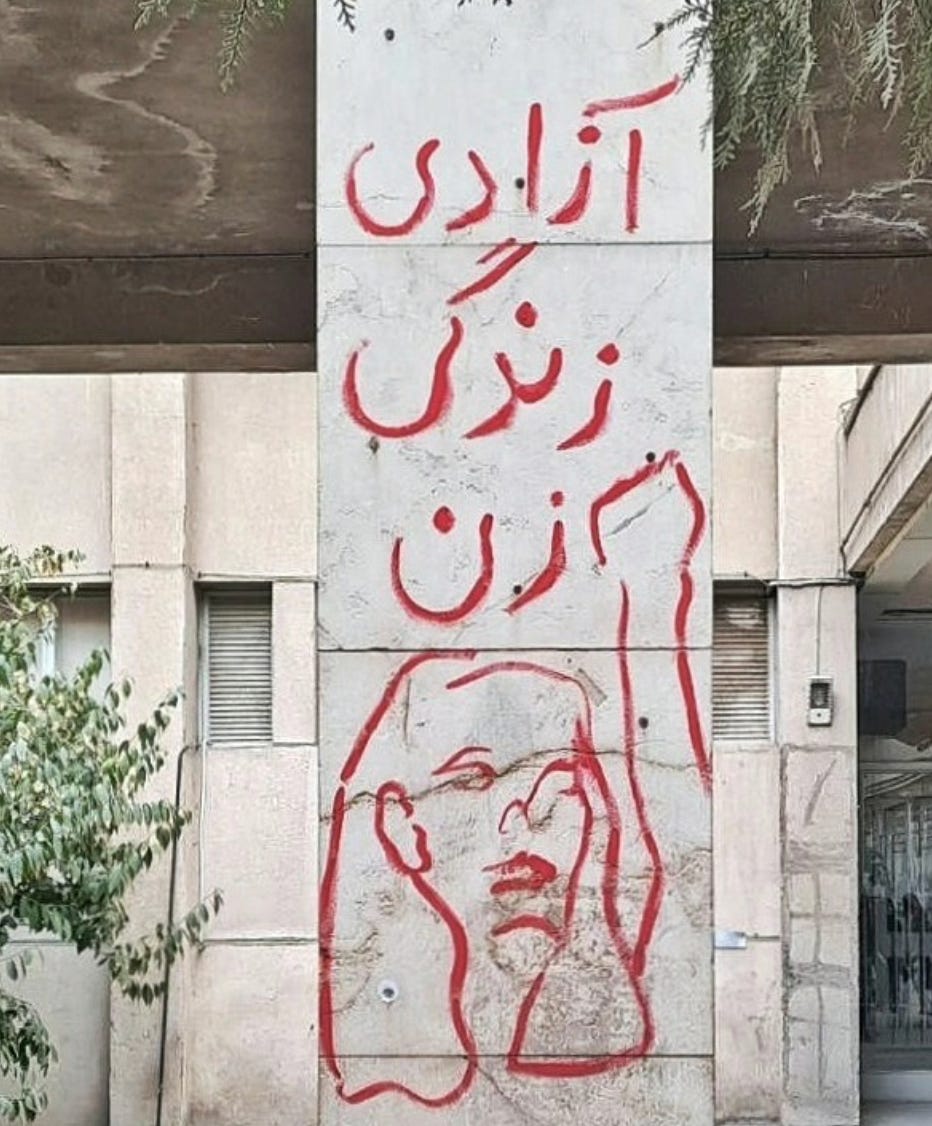
I’m reading Woman, Life, Freedom: Voices and Art from the Women’s Protests in Iran, the 2023 anthology compiled by Malu Halasa, including first-person accounts, photography, and artwork capturing the uprising that followed the death of student Jina Mahsa Amini. It’s full of images no photograph could capture safely: women burning headscarves, students facing down morality police, the raw courage of ordinary people demanding what should not require courage to demand.
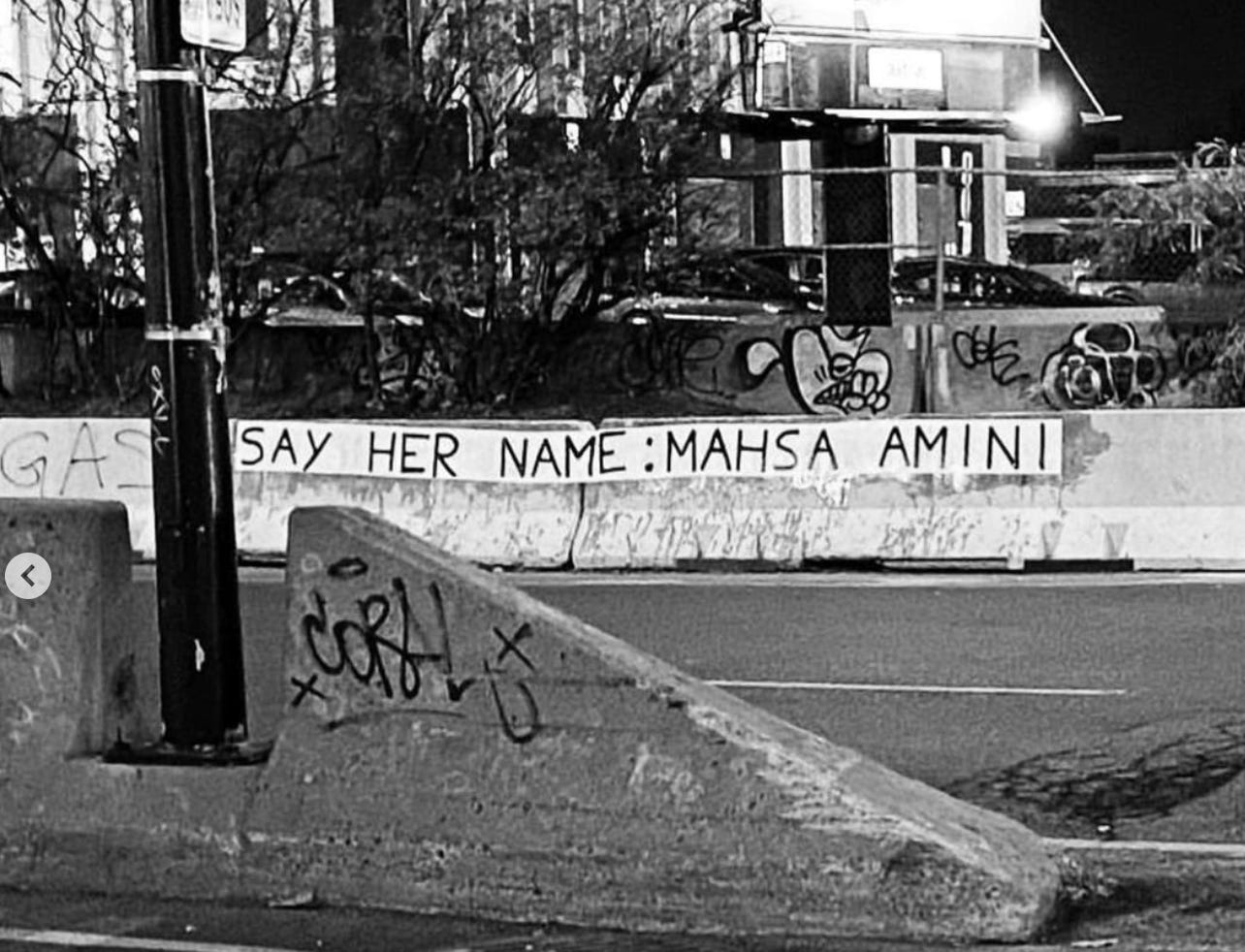
In December 2017, Vida Movahed climbed onto a utility box on Tehran’s Enghelab Street—Revolution Street—removed her white hijab, tied it to a stick, and waved it like a flag. She was arrested immediately, with her 19-month-old baby beside her. Within weeks, dozens of women reenacted her protest on the same spot, each risking prison, each filmed by bystanders and shared with the world. The regime changed the utility box to a pointed gable to prevent anyone from standing there again. Wikipedia
In 2022, red paint splashed across a propaganda mural of Khamenei - a gesture of defiance that spread across social media. Photographer Shiva Khademi has documented how Iranian women use hair color itself as protest: bright reds, violets, streaks of visible rebellion against the compulsory gray of state control.
Dr. Pamela Karimi, in Alternative Iran: Contemporary Art and Critical Spatial Practice, shows how dissident art has been central to revolutionary demands for civil rights, women’s rights, and democracy. One artist literally rolled through the streets of Mashhad to reclaim public space. A dancer reenacted protest gestures in public squares. Political poets merge ancient traditions of public recitation with modern practices of poetry jamming. These are “practices of hope for a more democratic Iran,” Karimi writes of protest art emerging from Iranian streets that “is not just a pretense of protest but protest itself.”
This is what the Iranian people, particularly women and artists, have been building for decades, under surveillance, at risk of imprisonment and execution.
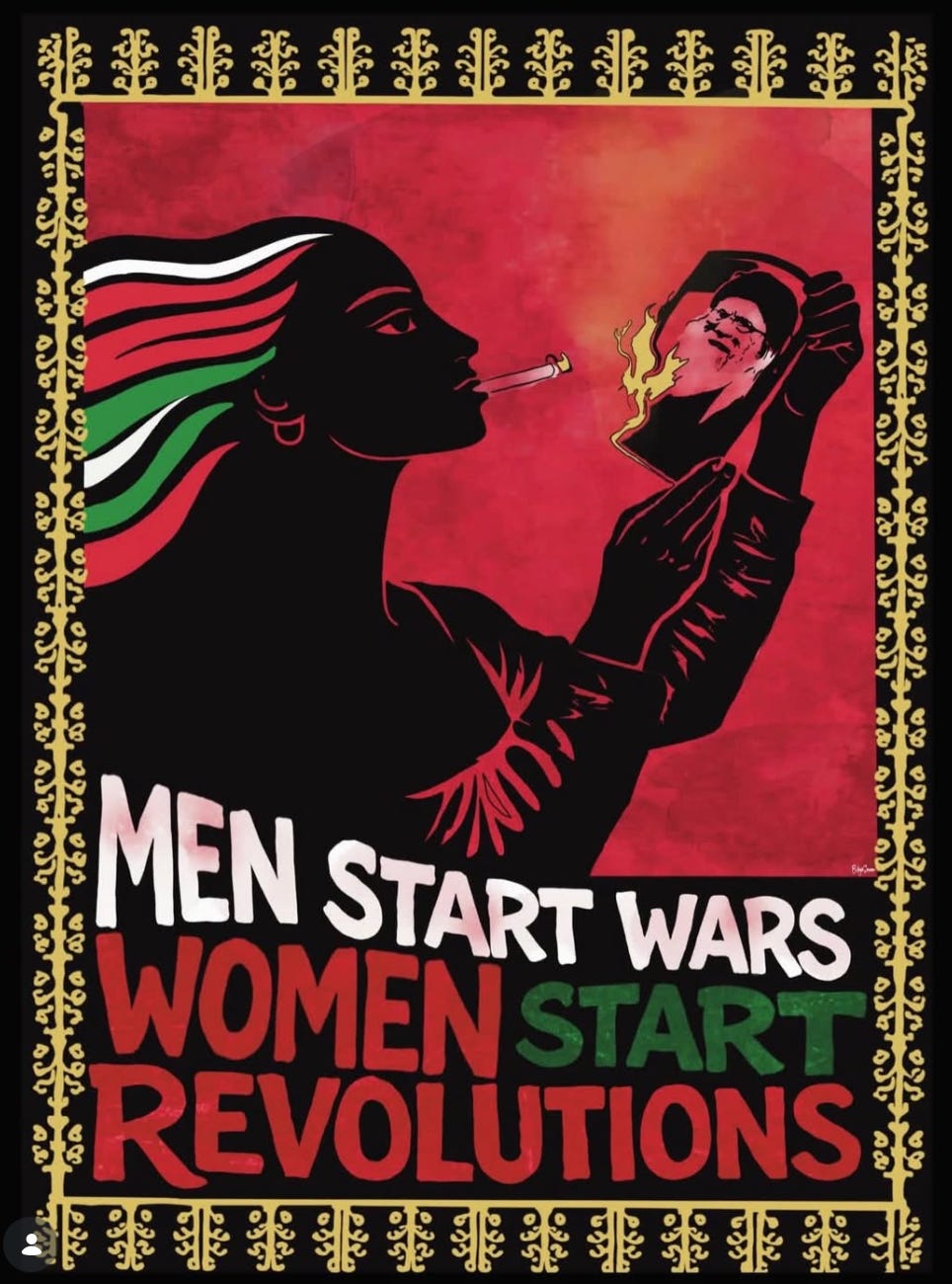
In January 2026. Khamenei ordered security forces “to crush the protests by any means necessary.” The result was the deadliest crackdown since 1979, with thousands killed in 48 hours, tens of thousands arrested, and a total internet blackout to hide the scale of the massacre.
Six weeks later, on February 28, 2026, the United States and Israel launched airstrikes on Iran, killing Khamenei and inflicting mass civilian casualties.
For decades, the United States positioned itself as a champion of human rights and democracy - the friend of dissidents, the enemy of tyrants. That pretense is now fully abandoned.
Bombs do not empower dissidents. They empower despots. They give authoritarian regimes the external enemy they need to justify repression, to label every protester a foreign agent, to rally nationalist support around a government that was, just weeks before, massacring its own people in the streets.
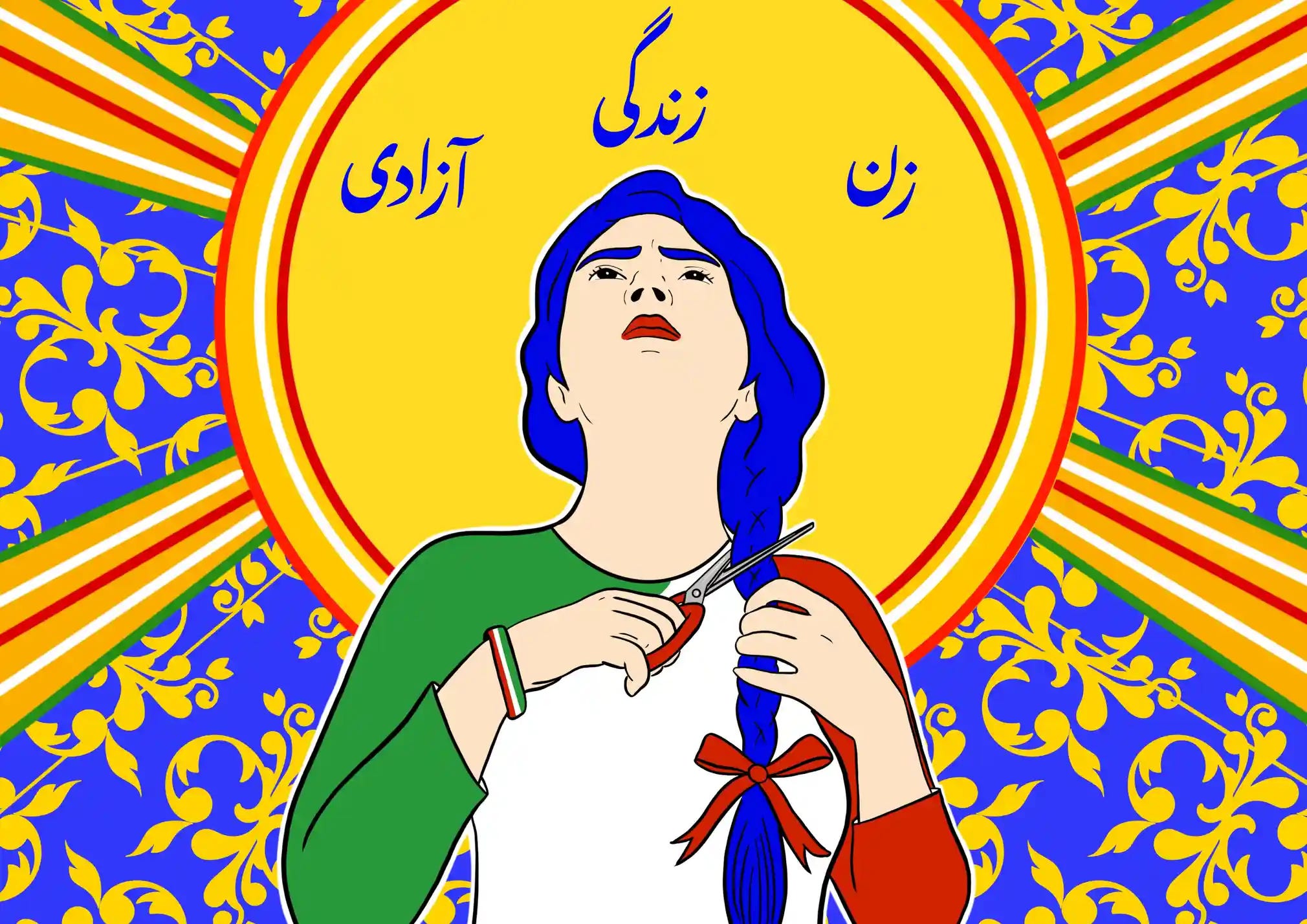
The women waving white scarves on sticks, the artists splashing paint on murals, the photographers documenting quiet acts of courage, the poets risking prison for a verse were not waiting for American missiles. They were building something. They had been building it for years.
“Raised fists, flowing scarves and bold female figures,” says illustrator Roshi Rouzbehani. “All these elements reflect the movement’s core spirit: autonomy, resistance, and hope.” In These Times
We have been bombing that hope.
“Right to Read Day”
Right to Read Day is April 20th. Uniteagainstbookbans
The American Library Association (ALA) condemned the March 17, 2026 passage of H.R. 7661 by the House Committee on Education and Workforce, a bill that would modify the Elementary and Secondary Education Act to prohibit funds for materials deemed “sexually oriented,” effectively giving politicians broad authority to restrict whose stories appear on shelves. American Library Association
Publishing imprints for young readers are shuttering thanks to a “softening” school and library market, which is a direct result of book censorship. Congresswoman Ayanna Pressley has introduced the Books Save Lives Act of 2026 to counteract the harm of book bans nationwide.
Machines Can’t Be Authors: Thaler v. Perlmutter
On March 2nd, the Supreme Court declined to hear Thaler v. Perlmutter, leaving in place the D.C. Circuit’s ruling that copyright protection under U.S. law requires human authorship. Dr. Stephen Thaler’s effort to copyright an image his AI created autonomously—with no human prompting or editing—is over. Holland & Knight
Thaler listed the “Creativity Machine” as the work’s sole author. The Copyright Office rejected the application because it “lack[ed] the human authorship necessary to support a copyright claim.” The D.C. Circuit affirmed, but narrowed the holding: “The rule requires only that the author of that work be a human being—the person who created, operated, or used artificial intelligence—and not the machine itself.” Constitution Center
This framing actually makes intuitive sense when you consider how authorship has always worked in practice. Rubens ran a workshop where assistants executed significant portions of his paintings he designed. Warhol’s Factory employed dozens of people producing silkscreens. Jeff Koons directs fabricators who physically create his sculptures. Damien Hirst’s spot paintings were executed almost entirely by assistants—he reportedly painted only five of over 1,400 works in the series.
In literature, the tradition is equally long. Alexandre Dumas employed collaborators who drafted novels from his outlines. Contemporary writers routinely work with research assistants, developmental editors, and ghostwriters. Academic and political figures publish under their own names work substantially drafted by others.
In all these cases, the law assigns authorship and copyright to the person who is the generative force behind the work: the one who conceives it, directs its execution, and takes responsibility for the final product. The skilled hands that execute the vision don’t become authors, even when their technical contribution is substantial.
AI, viewed this way, is simply another tool in the studio, a very sophisticated assistant that executes according to human direction. The question isn’t whether the assistant (human or machine) contributed skill and labor. The question is who supplied the animating creative vision.
Thaler’s case was easy precisely because he disclaimed any creative role. He listed the machine as the sole author. Thaler deliberately set up the narrowest possible dispute: he disclaimed any human creative contribution and asked for copyright protection anyway.
The harder cases involve humans who do direct the AI substantially. Allen v. Perlmutter, pending in Colorado, involves an artist who entered text prompts at least 624 times, used the AI’s variation and upscaling tools, then used Photoshop to refine the result. Even so, the Copyright Office takes the position that the work’s underlying expressive elements were generated by AI, not authored by Jason Allen.
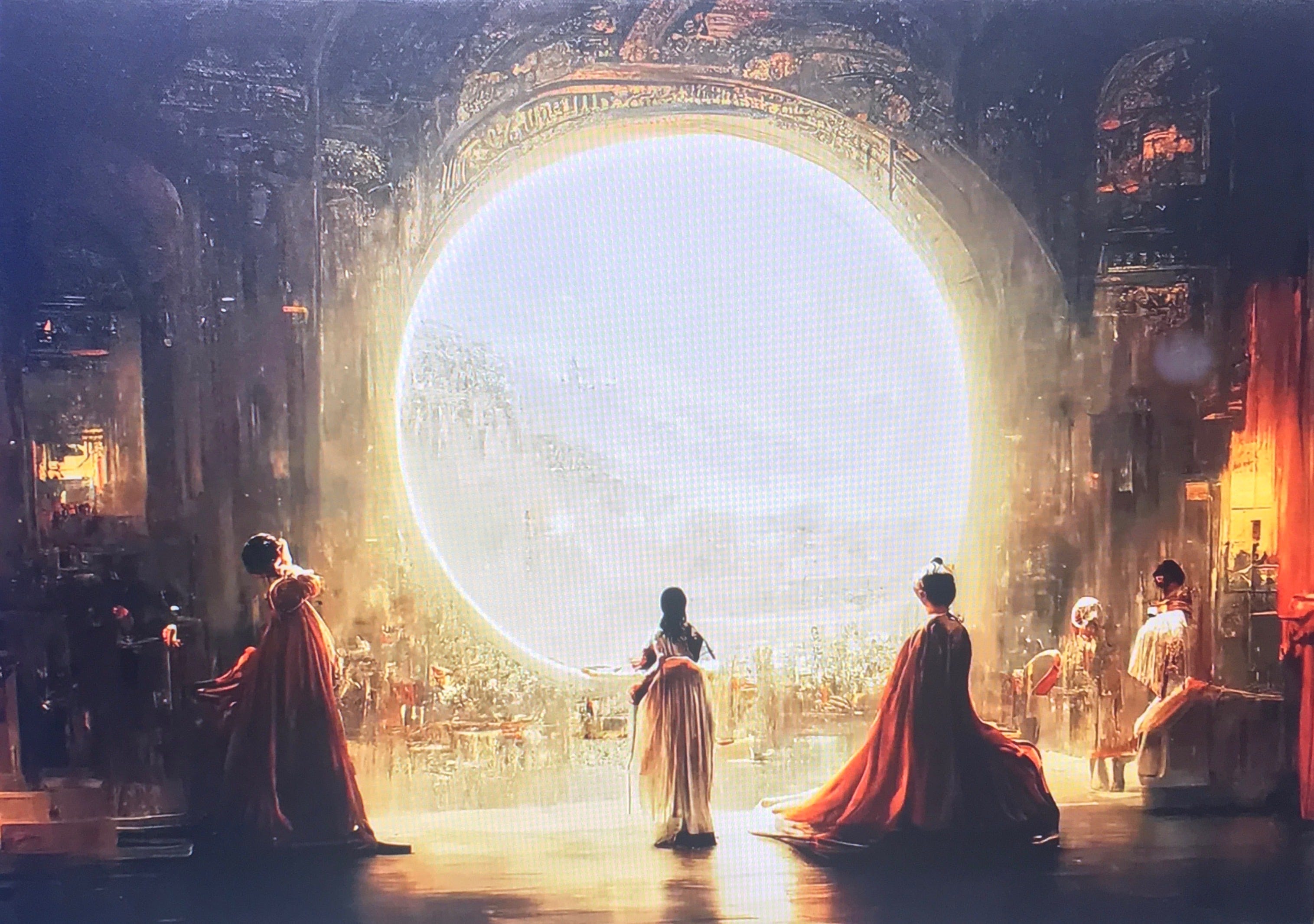
The studio analogy should cut in Allen’s favor. If Koons can direct fabricators through detailed specifications and retain authorship, why can’t Allen direct Midjourney through 624 iterative prompts? That’s the real fight: whether prompting is closer to authorship or closer to curation. Copyright Lately
The human authorship requirement makes sense as a threshold for copyright protection; we grant exclusive rights to incentivize human creativity, not machine output. But there’s a civil liberties wrinkle worth watching.
The Copyright Office now requires disclosure of AI involvement in registration applications. If that disclosure is used to deny protection to work where a human exercised genuine creative control, it starts to look like a penalty on speech based on the tools used to create it.
To the extent a tool serves an expressive purpose, the First Amendment applies. In most cases, the government can no more compel an artist to disclose whether they created a painting from a human model as opposed to a mannequin than it can compel someone to disclose that they used artificial intelligence tools in creating an expressive work. Fire
The courts haven’t reached this question yet. But as AI tools become ubiquitous, the line between “AI-assisted” and “AI-generated” will become the crucial distinction, and how that line is drawn will determine whether the human authorship requirement functions as a sensible limit or an unconstitutional burden on human speakers using new tools.
The message from the courts is consistent: If you want IP protection, there must be a human in the process. The challenge is applying it consistently. A painter who directs skilled assistants is still the author. A writer who works with researchers and editors is still the author. The question going forward is whether a human who directs AI with comparable intentionality will receive the same recognition—or whether the novelty of the tool will obscure the continuity of the creative relationship. Reed Smith
Texas, the Bible, and the Establishment Clause
Last week, the Texas State Board of Education gave preliminary approval to a mandatory reading list featuring more than a dozen Bible passages, from the Parable of the Prodigal Son to the Book of Job. The majority-Republican board voted 9-5 to approve the list, which will become mandatory for all Texas public schools starting in 2030, pending a final vote in June. The Texas Tribune
The constitutional question isn’t whether the Bible can appear in public school curricula - it can. In Abington School District v. Schempp (1963), Justice Clark wrote that the Bible “is worthy of study for its literary and historic qualities” and that “such study of the Bible or of religion, when presented objectively as part of a secular program of education, may not be effected consistently with the First Amendment.” Justia
The key words are “objectively” and “secular.” Teaching about the Bible’s influence on literature and history is permissible; using the Bible as moral instruction is not. And the Establishment Clause requires neutrality; the government cannot “pass laws which aid one religion, aid all religions, or prefer one religion over another.” Justia
Texas’mandatory reading list does not meet the requirements of the First Amendment. Critics raised concerns about the lack of religious diversity; the list incorporates biblical material, while other religious traditions are barely represented. Some of the biblical entries reference the Hebrew Bible, and state officials noted that one story, “The Hare in the Moon,” is rooted in Buddhist tradition. But that hardly approaches the degree of religious diversity needed for Texas to argue it’s staying neutral on religion. Chattanooga Times Free Press
The list could add excerpts from the Jataka Tales, the Bhagavad Gita, or the Analects of Confucius. There should be space for excerpts from the Quran, too. If the goal is genuinely literary and historical to teach an understanding of how sacred texts have shaped human civilization, then a list featuring only Christian scripture isn’t neutral. It’s preferential.
The phrase “separation of church and state” doesn’t appear in the Constitution - it comes from Jefferson’s 1802 letter to the Danbury Baptists. Critics of that phrase sometimes argue it’s been distorted beyond recognition. But the Establishment Clause itself is constitutional text, and its meaning has been elaborated through two centuries of judicial interpretation.
The Schempp Court decision also stated: “This Court has decisively settled that the First Amendment’s mandate has been made wholly applicable to the States by the Fourteenth Amendment.” It also “rejected unequivocally the contention that the Establishment Clause forbids only governmental preference of one religion over another.” Justia
The question isn’t whether the Founders and authors of the U.S. Constitution valued religion, many did. The question is whether the government can use its power over public education to promote particular religious content to captive audiences of children. The courts have consistently said no.
The current effort follows on Texas’s Ten Commandments display mandate (currently blocked by federal courts in over two dozen districts), an optional Bible-based elementary curriculum, and state-authorized school chaplains. When the same biblical passages appear in both a “literary” reading list and a religiously-oriented curriculum, it becomes harder to argue the purpose is purely secular. Community Impact
Religious freedom means parents, not the state, decide how children encounter sacred texts. The final vote is in June.
FTC vs. Media Matters
The Federal Trade Commission (FTC) went before a skeptical D.C. Circuit panel recently, struggling to defend its civil subpoena of Media Matters — the nonprofit watchdog that reported on the surge of white nationalist and antisemitic content on Elon Musk’s X, and the advertiser exodus that followed.
The FTC claims its “civil investigative demand” is simply part of a broader antitrust probe into whether major advertisers illegally colluded to boycott X. Media Matters sees it differently: the subpoena demands journalist notes, editorial processes, financial records, and organizational affiliations — the full apparatus of a newsroom stripped bare — and it arrived after Musk promised a “thermonuclear” lawsuit, after the Texas AG launched an identical probe, after the Missouri AG piled on, and after FTC Chair Andrew Ferguson publicly bragged about “standing up to the radical left.”
The three-judge panel wasn’t buying the FTC’s framing. Judge Patricia Millett cut to the chase: “Either they’ve been swept up in some other investigation for one reason, and one reason only, or perhaps the entire investigation somehow thinks it is an illegal advertiser boycott to expose Nazi misinformation.” She asked Ferguson’s lawyer directly, “What’s radical left about being anti-Nazi?” The response: Don’t read too much into a political appointee’s political statements. Source
Judge Gregory Katsas, a Trump appointee, added that First Amendment retaliation can’t simply be treated as the “cost of doing business with the government.”
The pattern here is unmistakable. Texas. Missouri. And now the FTC. Each probe a near-identical instrument, each one targeting the same organization for the same act of journalism. The district court already found retaliatory animus. The appeals court appears to agree. Reporting on hate speech shouldn’t make you a federal target. That it has tells you everything about who the government is protecting.
Dance Protest at The Lincoln Memorial
The Lincoln Memorial has witnessed demands for justice before — from Marian Anderson to the March on Washington. This time, the voices were bodies in motion. Twelve young women and girls, wearing black blindfolds and light-blue leotards printed with passages from the Epstein files, took one of the nation's most symbolic grounds to assert what law and government have too often refused to give them: the right to name their abusers, tell their own story, and be believed.
The performance lasted barely two minutes. It opened with fifteen-year-old lead dancer Devyn Scherff alone on the promenade — skin-tone leotard, no blindfold — seeming to fight off an attack, then shrink away. As the others joined her, Madonna's "Live to Tell" played from a speaker, sung by a children's choir: a man can tell a thousand lies / I've learned my lesson well. The dancers fluttered, flexed, and weaved beneath Lincoln's gaze.
Holding the Line: Two Leaders Who Won’t Let History Be Erased
At a recent discussion hosted by F.A.C.T. ally, the National Coalition Against Censorship (NCAC), two institutional leaders offered something rarer than commentary — they offered testimony.
Ann Burroughs is President and CEO of the Japanese American National Museum (JANM) and its Daniel K. Inouye National Center for the Preservation of Democracy, an internationally recognized figure in human rights and social justice whose biography gives her particular authority on the subject of state-sanctioned harm. Her lifelong commitment to racial justice was shaped by her experience as a young activist in South Africa, where she was jailed as a political prisoner for her opposition to apartheid. She brings that experience to bear on a museum whose very ground carries its own weight: JANM sits on the site in Los Angeles’s Little Tokyo where more than 37,000 Japanese Americans were ordered to report and board buses bound for incarceration camps in 1942. Japanese American National Museum
When the current administration moved to roll back DEI programs and the Smithsonian began scrubbing its websites, JANM’s board took a different path. They instituted their own policy called “Scrub Nothing.” The museum refused Trump’s call to end DEI initiatives even though the decision cost it around $1.7 million in federal funding. Museum trustees whose own families had been incarcerated during World War II saw it plainly: the same disinformation used to dispossess their parents and grandparents was being deployed again. By publicly refusing fascist pressure and appealing to their community, they raised lots of money, making up for the federal cuts. Zócalo Public Square
Joining Burroughs at the NCAC event was Dr. Yomaira Figueroa-Vásquez, the eighth Director of CENTRO — the Center for Puerto Rican Studies — and the first Afro-Puertoriqueña to lead the institution in its fifty-year history. A professor of Africana, Puerto Rican, and Latino Studies at CUNY Hunter, her scholarship centers on Latinx Caribbean and Afro-Hispanic literatures, women of color, and decolonial feminisms. Her current book project, The Survival of a People (forthcoming from Duke University Press), examines the disappearances and erasures of Afro-Puerto Rican peoples through familial stories, archival histories, photography, and film — the kind of work that, in this climate, is itself an act of institutional courage. Yomairafigueroa
Figueroa-Vásquez brought the argument against censorship into sharp relief through her own firsthand experience of censorship. Diasporic Collage: Puerto Rico and the Survival of a People — a years-in-the-making exhibition she co-curated for the Michigan State University Eli and Edythe Broad Art Museum, rooted in Frank Espada's landmark documentary photography project on the Puerto Rican diaspora. Days before its public opening, MSU upper administration demanded the exhibition be "adapted" — targeting specifically a work by artist Alia Farid based on a 1973 archival photograph from a Puerto Rican newspaper, moving it to a less visible wall and adding an unsanctioned content warning at the gallery entrance, all within thirty minutes of informing the curators. The public opening was canceled — artists, curators, and collaborators of color were told to enter through the service door while white donors and board members used the front entrance. The State News
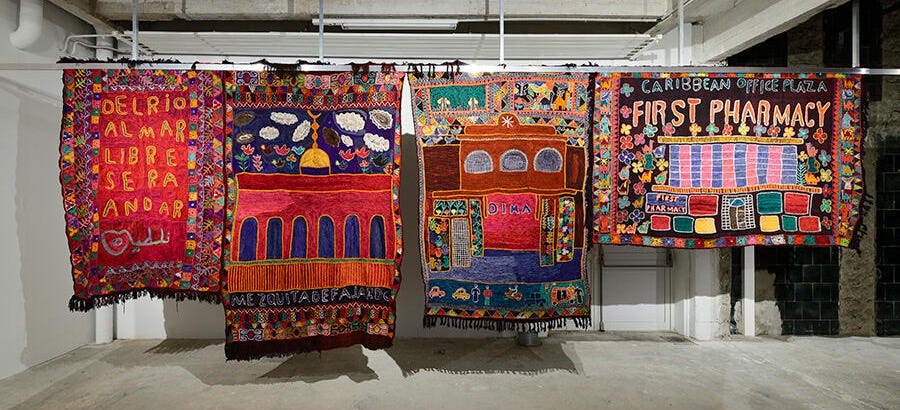
For Figueroa-Vásquez, the incident crystallized what's at stake when heritage gets treated as something to be managed, neutralized, and safely archived away from the present tense. She noted that what MSU demonstrated was "what happens when an institution has very little understanding of the context of a place and tries to intervene ahistorically." The exhibition's guiding premise — that Puerto Rican identity and history are alive, in motion, layered with contemporary political consciousness, not a relic to be displayed at a safe distance from the present — was precisely what made it threatening.
NCAC has been front and center in this moment. In August 2025, NCAC and New York’s Vera List Center for Art and Politics released “Cultural Freedom Demands Collective Courage,” a nationwide statement of values for the field of arts and culture, signed by more than 150 cultural institutions and 275 individuals, in direct response to the NEA terminating over $27 million in grants. As NCAC’s director of arts and culture advocacy has put it, preemptively adjusting programs to appease would-be government censors will erode the integrity of our cultural institutions and the independence of the field as a whole. Artnet News
What Burroughs and Figueroa-Vásquez represent — institutions built by and for communities whose histories the state has repeatedly tried to suppress — is exactly the kind of moral clarity NCAC’s coalition is trying to galvanize across the sector. The question isn’t whether to resist. It’s whether enough institutions have the standing, the community backing, and the nerve to do it together.
Acknowledgement
We are always grateful for the encouragement and suggestions of our colleagues and peers.
NEXT STEPS: TAKE ACTION
First Amendment Friday
F.A.C.T. invites all cultural institutions, artists, and activists to post First Amendment stories, graphics, calls to action, and advice to their audience every Friday. Join our campaign by signing up here. Feel free to use our digital assets here.
Public Practice
We are asking cultural venues in New York City (and across the USA) to prominently place our First Amendment poster in their public areas. Sign up to get your copy. We are also asking performance venues to share our curtain speech (or create your own).