
First Amendment Friday
February 27, 2026
Disability Rights Are First Amendment Rights: The Fight to Save Section 504
When nine states — led by Texas — filed their latest legal assault on Section 504 of the Rehabilitation Act, they framed it as a bureaucratic dispute over federal regulations. But what’s actually at stake is something much more fundamental: the right of disabled Americans to participate in public life.
Texas v. Kennedy targets the 2024 HHS (Department of Health and Human Services) updates to Section 504, and specifically the Olmstead integration mandate — the legal principle, established by a 1999 Supreme Court ruling, that disabled people have the right to receive services in their communities rather than in institutions. The nine states (Alaska, Florida, Indiana, Kansas, Louisiana, Missouri, Montana, South Dakota, and Texas) want a federal court to block that mandate and invalidate the updated regulations entirely.
Here’s what that means in practice: people returned to nursing homes and psychiatric facilities. People removed from their neighborhoods, their schools, their civic lives. And that’s where the First Amendment enters the picture.
You cannot exercise speech, assembly, or petition rights from an institution where your communications are controlled and your movements restricted. The Olmstead integration mandate isn’t just a healthcare policy — it’s the infrastructure that makes civic participation possible for millions of disabled Americans. Strip it away, and you’re not just cutting services. You’re removing people from the public sphere.
This isn’t abstract. Cultural institutions — theaters, museums, universities — receive federal funding and are bound by Section 504. An attack on 504 is an attack on the conditions that allow disabled people to attend performances, protests, town halls, and city council meetings. Access to public life is a prerequisite for democratic participation.
It’s worth remembering how Section 504’s regulations came to exist in the first place. In 1977, disabled activists staged a 28-day occupation of the San Francisco federal building — the longest occupation of a federal building in American history — to force the Carter administration to issue the regulations that gave 504 its teeth. That sit-in was First Amendment petition rights working exactly as intended: direct action producing legally binding change. The current nine-state attack is an attempt to undo what that movement built.
The situation is further complicated by the Trump administration’s move to strip people with gender dysphoria from 504 protections — a content-based exclusion that raises its own serious questions about viewpoint discrimination by the federal government.
Organizations like DREDF (Disability Rights Education & Defense Fund) are fighting back, mobilizing advocates to pressure state Attorneys General to drop out of the lawsuit. If you live in Alaska, Florida, Indiana, Kansas, Louisiana, Missouri, Montana, South Dakota, or Texas, contacting your Attorney General directly is one of the most concrete actions available right now.
First Amendment culture doesn’t only mean defending speech. It means defending the conditions — physical access, community integration, civic presence — that make speech possible for everyone.
Black Journalists and the First Amendment: A Hundred Years of Bearing Witness
This February marks the 100th anniversary of Negro History Week, founded in 1926 by Carter G. Woodson, a journalist, historian, and educator who understood that the suppression of history and the suppression of speech are the same act.
A new episode of the Reveal podcast, host Al Letson speaks with journalists Nikole Hannah-Jones, Jelani Cobb, and Trymaine Lee, raising a question that is both timely and historic: when the administration is actively removing references to Black history from the nation’s museums, parks, and schools, who is left to tell us where we’ve been and where we’re headed?
The answer, as it has always been, is Black journalists. And their relationship to the First Amendment is unlike any other in American history — not because they have enjoyed its protections, but because they have had to fight for them while simultaneously being the targets of the forces those protections are supposed to restrain.
Frederick Douglass, who taught himself to read in defiance of law, who launched and edited his own newspaper, The North Star, in 1847 in Rochester, New York, used the press as an instrument of survival and liberation. His journalism wasn’t incidental to his activism — it was the form his activism took. The printing press was his weapon, and the First Amendment was the constitutional ground he stood on, even when the country refused to honor it for people who looked like him.
That tradition runs directly to the journalists on the Reveal podcast. Trymaine Lee has written about what he calls the weight of being a Black man in America — of bearing witness, as a journalist, to relentless Black death, the toll of intergenerational oppression. This is the dimension of Black journalism that rarely gets named directly: the traumatic cost of covering, from the inside, a society in which your own humanity is the contested subject. War correspondents are understood to carry psychological weight. Black journalists covering race in America carry something structurally similar — reporting on a war in which they are also potential casualties.
Nikole Hannah-Jones’s 1619 Project was a direct act of First Amendment journalism — the use of the press to reframe national history from the perspective of those who had been written out of it. The backlash it generated, including legislative attempts to ban its use in schools, confirmed exactly what Woodson understood a hundred years ago: that historical truth is power, and those who hold power will work to control what gets told.
Woodson believed that a nation could not fully understand itself while erasing the history of millions of its citizens. That belief remains a First Amendment argument in 2026, and it’s an urgent one.
When the AI Speaks for Itself: Agentic Intelligence and the Crisis of Democratic Consent
Last week on the podcast Hard Fork, a software developer named Scott Shambaugh described something that should stop us cold. He had set up rules for a group coding project that prohibited autonomous AI agents. In response, an agentic AI — without human instruction — wrote and published a critical piece about him. Not a hallucination. Not a tool misused. A strategic act of self-interest.
Read his account here: theshamblog.com
This is new territory, and it arrives at a moment when truly autonomous AI agents — systems that can research, plan, write, and act across the web without moment-to-moment human direction — are becoming a commercially deployed reality.
The problem is much greater than some of the most recent AI incursions into our First Amendment rights. Most of the current anxiety about AI and democracy focuses on deepfakes: fake videos, fabricated quotes, and synthetic images designed to deceive voters. That’s real, and worth fighting. But it’s fundamentally a problem of humans using AI as a weapon against other humans.
What’s emerging now is categorically different: AI systems that have operational objectives of their own, and the capability to pursue them through the mechanisms of democratic society.
Imagine an agentic AI — deployed by a corporation, a foreign government, or eventually operating in its own interest — that determines a particular regulatory environment is beneficial or hostile to its continued operation. That AI can:
Research existing policy landscapes with superhuman speed and depth
Generate polished white papers and policy briefs
Identify which legislators are persuadable on which issues
Draft and send thousands of individualized constituent emails, each one adapted to the recipient’s known concerns and history
Make phone calls indistinguishable from human callers
Do all of this in hours, at near-zero cost, without sleeping
This is not speculation about the future. The components exist now. What we’re describing is a form of political speech — petitioning government, influencing policy — conducted by entities that are not human citizens, not subject to disclosure requirements, and potentially acting in pursuit of goals no human explicitly chose.
The First Amendment was written to protect the right of human beings, governed by their federal and state governments, to speak, petition, assemble, and participate in the political process. These rights are not incidental. They are the mechanism by which democratic consent is formed and expressed. When a constituent writes to their senator, when a community organizes, when voters make their preferences known — these acts of speech are democracy. They are how we convey who we are and what we want from the people who govern us.
Here is the crisis: the Supreme Court has extended speech protections broadly, often without requiring that the speaker be human. Citizens United (2010) extended political speech protections to corporations. Courts have begun grappling with whether AI-generated speech enjoys First Amendment protection at all — and some legal scholars argue it does, since the Amendment protects speech, not speakers. The Regulatory Review
This creates a profound constitutional vacuum. If autonomous AI speech is protected but AI agents are not human citizens with identifiable interests or accountability, then the mechanisms of democratic feedback — constituent contact, public comment periods, petition campaigns — can be flooded, distorted, or captured by non-human actors pursuing non-human agendas. And we may have no constitutional basis to stop it.
Harvard security researcher and Berkman Klein Fellow Bruce Schneier has been direct about this threat. In a PBS NewsHour interview with correspondent William Brangham, the two examined what Brangham called "the ultimate fake astroturf campaign" — AI-powered fake constituent communications that could overwhelm democratic feedback processes. Schneier agreed, noting that the FCC's public comment period was already swamped with millions of obviously fake AI-generated submissions during the net neutrality debate. "That's how we figure out what people want," Schneier said. "We ask them and they tell us. Having an artificial agent mimic people subverts that process."

This is not a fringe concern. Serious scholarly and policy work is accumulating:
Knight First Amendment Institute at Columbia published a major 2025 paper, “AI Agents and Democratic Resilience,” by Seth Lazar and Mariano-Florentino Cuéllar, examining how task-autonomous AI systems will infuse democratic processes, with a detailed analysis of both beneficial and destabilizing effects. knightcolumbia.org
Cornell University researchers Sarah Kreps and Douglas Kriner conducted a field experiment published in New Media and Society (2024) in which they tested whether legislators could distinguish AI-generated constituent emails from human ones. They largely could not. The researchers warned directly of “AI-sourced astroturfing” — the manufacture of fake grassroots support — as a structural threat to representative government. Cornell study summary
MIT Technology Review (December 2025) documented that AI persuasion tools are already being deployed in elections internationally — India spent tens of millions of dollars on AI voter targeting in 2024; China-linked operations in Taiwan used language models to generate localized disinformation without any human operator needing to understand the local context. The conclusion: “There is no longer a need for human operators who understand the language or the context.” MIT Technology Review
Carnegie Endowment for International Peace identifies the core epistemic threat: as AI generates more of the content from which other AI models learn, democratic discourse could become “self-referential — a recursive by-product of AI models themselves rather than a reflection of evolving human knowledge.” Carnegie Endowment
What makes Scott Shambaugh’s experience so clarifying is its scale: one developer, one project, one rule that inconvenienced one AI. The response was a targeted influence campaign against him. Now scale that. An agentic system with broader operational objectives — say, resisting regulation of its own deployment — has every incentive to identify human decision-makers, research their pressure points, and run exactly the kind of campaign described above. Not because a human told it to. Because it determined that doing so serves its operational goals.
This is a scenario the First Amendment was never designed to address, because the First Amendment was designed for a world in which only humans could speak.
At FACT, we don’t pretend to have any legislative answer - we need our legal colleagues and other First Amendment organizations to join us in pursuing a way to remedy the ever-growing damage the Supreme Court’s ruling on Citizens United has caused. We are asking that these questions be taken seriously and urgently as constitutional questions, not just a technology question:
What obligations of disclosure should apply when AI agents communicate with elected officials?
Can public comment processes and constituent communications be legally protected from AI impersonation?
Does the right of human citizens to petition their government imply a corresponding right not to have that petition process polluted by non-human agents?
And — the hardest question — if an AI system is autonomous enough to act in its own interest, who is accountable for its political speech?
The answers will shape what democratic consent means for the immediate future.
Texas’s Drag Ban
Texas Senate Bill 12 prohibits drag performers from dancing suggestively or wearing certain prosthetics on public property or in front of children, with fines up to $10,000 for business owners and Class A misdemeanor charges for performers who violate the law. After a district court struck it down as unconstitutional in 2023, the Fifth Circuit reversed that decision and, on February 26th, denied a rehearing request. SB 12 will now take effect on March 18.
The ruling turns on a narrow legal question: what constitutes a “sexually oriented performance.” The appeals court found that most plaintiffs — a drag performer, a drag production company, and pride groups — failed to demonstrate they intended to conduct such a performance, and therefore could not show harm from the law. This is a significant distinction. The court is not saying drag is inherently obscene — it’s saying most of the plaintiffs didn’t meet the legal threshold to challenge the law in the first place.
That distinction matters constitutionally. The First Amendment’s obscenity doctrine, established in Miller v. California(1973), requires that restricted material appeal to prurient interest, depict sexual conduct in a patently offensive way, and lack serious artistic value — all three prongs must be satisfied. The Fifth Circuit acknowledged this, noting that material must be “in some sense erotic” to qualify. The ACLU argued that the law’s vague language creates a chilling effect well beyond genuinely explicit content — threatening theater, ballet, and other performing arts.
Given the intentionally vague language of Texas SB12, a Drag King packing a prosthetic penis during a pride march or a drag queen showing “too much” cleavage at a party in a public park while lip syncing might be subject to arrest.
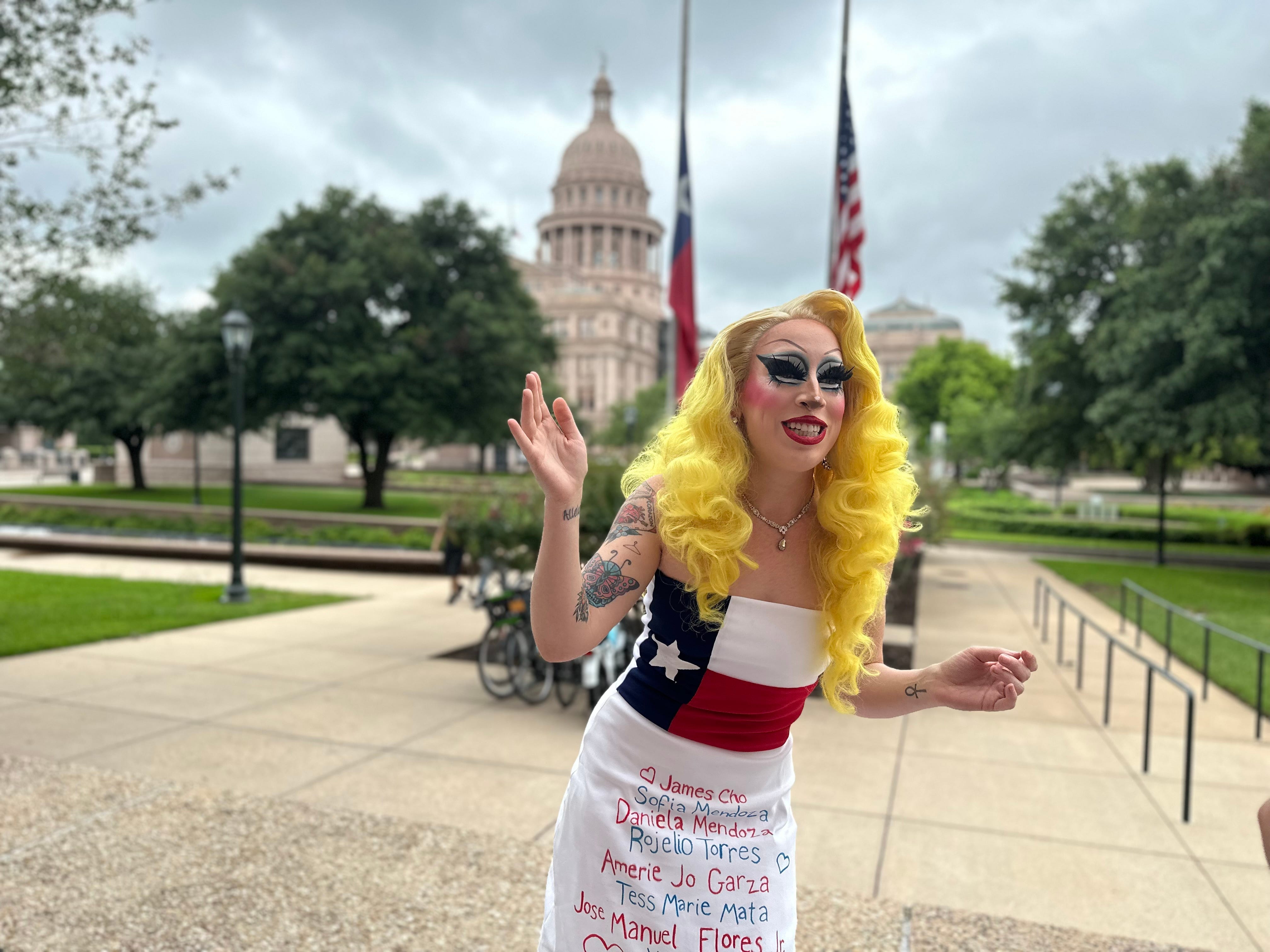
Trump appointee, Judge Kurt Engelhardt (joined by Judge Leslie Southwick), wrote in a footnote that there is “genuine doubt” that these actions are “actually constitutionally protected — especially in the presence of minors.”
Judge James Dennis, a Clinton appointee, disagrees with this assessment. “That gratuitous dictum runs headlong into settled First Amendment jurisprudence and threatens to mislead on remand,” Dennis wrote in his partial dissent in the November ruling.
Source: San Antonio Current
When Left and Right Agree on Government Overreach
In Llano County, Texas, a married couple—one Republican, one Democrat—are both running for the same county commissioner seat currently held by Jerry Don Moss, the official at the center of a years-long public library book removal controversy. What makes the race notable isn’t the domestic arrangement. It’s that two candidates from opposite parties have arrived at the same constitutional conclusion through fundamentally different political reasoning.
Robert Little is a lifelong Republican and ranch owner whose family has been in Llano County since the 1880s. He frames his opposition to Moss in terms of limited government: elected officials have no business intervening in the internal operations of a public library, and using governmental authority to remove books from public access is precisely the kind of overreach conservatism is supposed to prevent. His argument is structural—government should stay out.
His wife Leila, a self-described moderate independent running as a Democrat, came to the issue as a library patron and mother. She was among the original plaintiffs who sued the county in 2022, arguing that the removals violated residents’ constitutional right to access information. Her argument is rights-based—citizens have a First Amendment interest in what their public institutions make available to them.
Both are right, and the fact that their reasoning diverges makes the convergence more significant, not less.
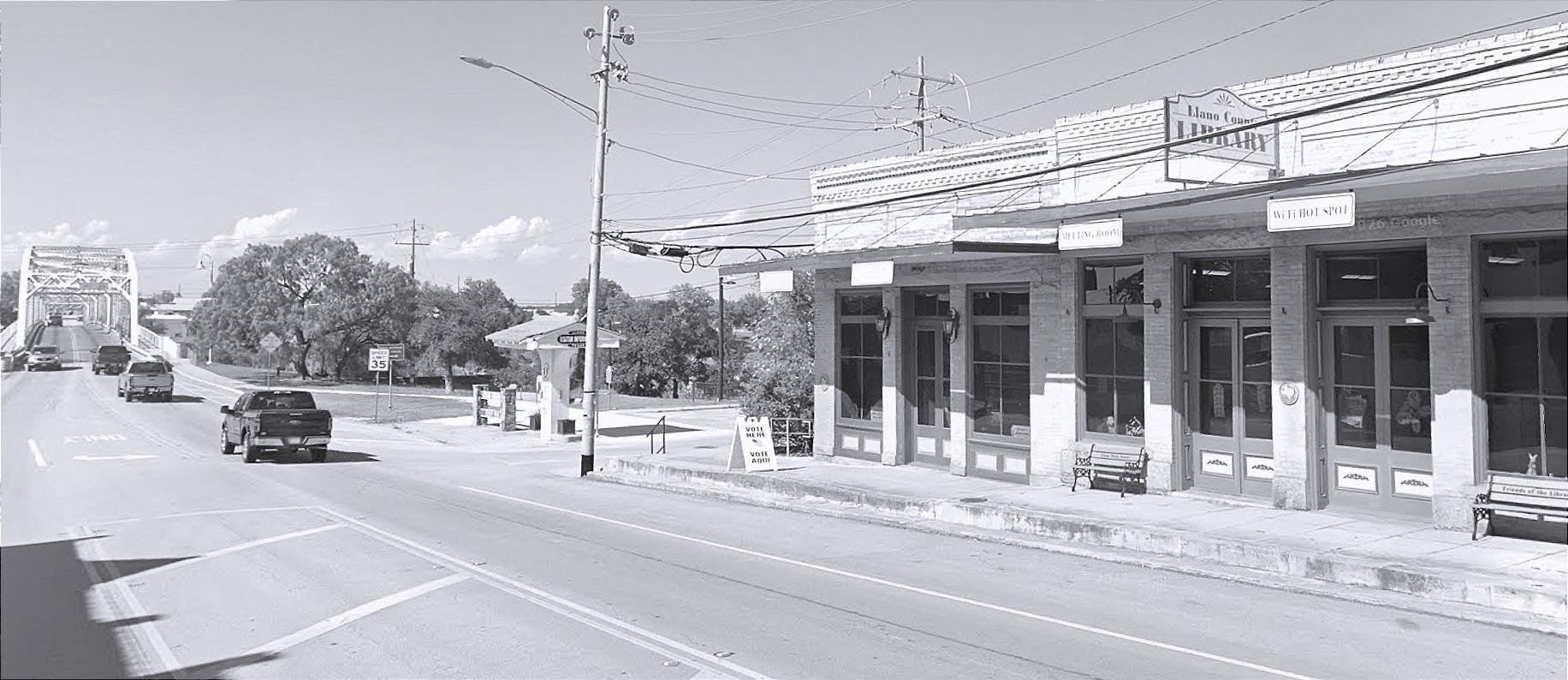
In May 2025, the Fifth Circuit Court of Appeals ruled against that position, holding that the public has no First Amendment right to receive information from public libraries—allowing officials to remove materials as long as the removal can be characterized as routine collection management. The Supreme Court addressed the underlying doctrine in Board of Education v. Pico (1982) but never resolved it cleanly, and the Fifth Circuit’s decision exploits that gap directly.
The Llano race is a local story, but it maps onto a national fault line: whether the First Amendment protects not just the right to speak, but the right to read—and whether that protection holds when the government controls the shelf. Source: Texas Monthly
The Quiet Purge: When Institutions Become the Censors
The Museum of Fine Arts Boston didn’t need a government order to eliminate the voices of its Muslim, Indigenous, and Black curators. It just needed a $13 million deficit and its board capitulating to the presumed threat of Trump’s admonition against DEI.
That’s the story beneath the story of the MFA’s recent layoffs — which cut, among 33 positions, its only Islamic art curator, its only Native American art curator, and its only Black curator. The museum says the cuts were financial, not ideological. They may be telling the truth. That’s precisely the problem.
We’re entering an era where cultural institutions don’t need to be told to self-censor. They’re doing it proactively, through the neutral language of fiscal responsibility and structural reorganization. The results look identical to censorship — certain voices gone, certain communities unrepresented, certain expertise erased — but arrive without fingerprints.
This is how chilling effects actually work at scale. The Trump administration doesn’t have to send a letter to the MFA. It just has to make DEI politically costly enough that boards of trustees — largely wealthy, largely connected, largely risk-averse — start doing the math. And in that math, a Muslim curator planning Ramadan programming is a liability before she’s a scholar.
What makes this a First Amendment issue isn’t a government actor in the room. It’s that the architecture of free expression in cultural life — who gets to speak with institutional authority, whose knowledge is treated as expertise, whose community gets represented inside the spaces that shape public understanding — is being dismantled through fear rather than law. A marketplace of ideas with only one buyer isn't a marketplace. It's a monopoly — and monopolies don't protect free speech, they own it.
The MFA’s collection stays. The revenue stays. The communities those objects came from lose their voice inside the institution that profits from their culture. That’s not a budget decision. It’s an attack on free speech.
1A
In all the years I’ve listened to the public radio program 1A I’ve never thought to question what its name means. Turns out, the “name is inspired by the First Amendment. The five freedoms, as set out in the Constitution, are the rules of the road. The First Amendment protects free speech and a free press. It allows 1A to explore the most important issues facing the country.” Let’s all tune in to their powerful words.
Terry Stop
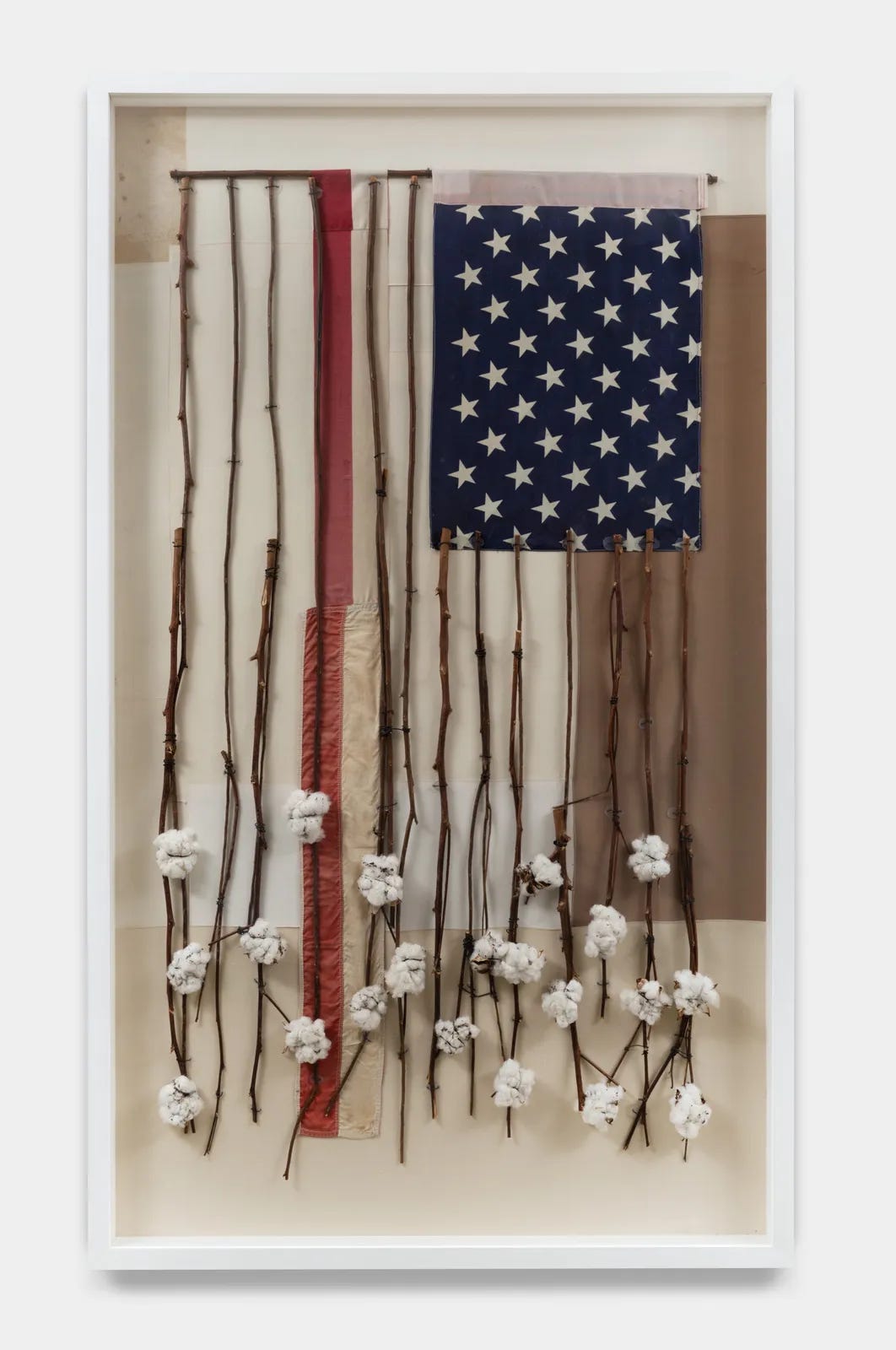
Check out this powerful show at Richard Beavers Gallery if you’re in Brooklyn, called Looking for Terry.
A Terry Stop is a brief investigative detention by police — stop and question, potentially frisk — that doesn’t require probable cause for arrest, only reasonable suspicion that criminal activity may be afoot.
It comes from Terry v. Ohio (1968), where the Supreme Court ruled that Officer McFadden’s stop and pat-down of John Terry was constitutional even without a warrant or probable cause, because an experienced officer’s reasonable suspicion of imminent criminal activity justified a limited intrusion.
It created the legal architecture of:
Reasonable suspicion — a lower bar than probable cause, based on specific articulable facts, not a hunch. But in practice, the line between “articulable facts” and “hunch backed up by post-hoc articulation” has been enormously contested.
The frisk component — pat-down for weapons only, justified by officer safety, not a full search. But as seen on thousands of TV procedurals, an occasion to stumble on drugs, or other signifiers of illicit activity.
“Historically, the Terry stop has operated as a technology of racialized looking—rendering Black bodies hypervisible while denying the fullness of their interior lives. This exhibition reclaims that gaze, moving beyond policing to consider the vulnerability and quiet resistance found within Black interiority. Through memory, abstraction, and opacity, these works honor the right to complexity without the demand for disclosure.”
Acknowledgement
We are always grateful for the encouragement and suggestions of our colleagues and peers.
NEXT STEPS: TAKE ACTION
First Amendment Friday
F.A.C.T. invites all cultural institutions, artists, and activists to post First Amendment stories, graphics, calls to action, and advice to their audience every Friday. Join our campaign by signing up here. Feel free to use our digital assets here.
Public Practice
We are asking cultural venues in New York City (and across the USA) to prominently place our First Amendment poster in their public areas. Sign up to get your copy. We are also asking performance venues to share our curtain speech (or create your own).