
First Amendment Friday
March 6, 2026
Comstockery Returns: An Old Law, a New Threat
A year ago, in January 2025, Fort Worth police walked into the Modern Art Museum of Texas and seized four photographs by Sally Mann — images of her children on a rural Virginia farm, taken decades ago and shown in major institutions worldwide. The exhibition they came from, Diaries of Home, was a group show featuring women and nonbinary artists examining family and home. The photographs were held as potential evidence of child pornography. A grand jury later declined to indict, and the works were eventually returned. FIRE’s director of public advocacy called it “a shocking abuse of government power” and declared that police had “picked a fight with the First Amendment and lost.” Glasstire
The First Amendment won that round. But the logic behind the seizure isn’t going away — and understanding where it comes from matters.
The author of the MTSU Free Speech Center analysis of the Mann case, art historian Amy Werbel, notes that the Fort Worth objections originated from the Danbury Institute, a Christian organization that accused Mann’s photographs of “normalizing pedophilia” and the exhibition of promoting “the breakdown of the God-ordained definition of family.” Anthony Comstock, she writes, similarly believed that “God’s Law” ought to be the guiding standard for American jurisprudence. Comstock is the direct legal ancestor of what’s happening now. The Free Speech Center
The 1873 Comstock Act grew directly out of his effort to silence Victoria Woodhull — a suffragist, stockbroker, and the first woman to run for president — because she had objected to the sexual double standard. When Woodhull was acquitted on obscenity charges, Comstock lobbied Congress to pass stiffer anti-obscenity laws, and Congress responded with the Act that bears his name. The Yale Law Journal
The Comstock Act criminalized not only the distribution of materials considered to be obscene, such as pornography by mail, but also the distribution of contraceptives, information about contraception, anatomy textbooks, birth control pamphlets, and health literature. The target was always the same: women’s access to information about their own bodies.
The consequences were immediate and sweeping. Between 1873 and 1880 alone, Comstock arrested more than fifty-five abortion providers and many persons supplying contraceptives. Birth control advocate Margaret Sanger was prosecuted under the Act for distributing reproductive health information through the mail. Free love advocate and women's rights theorist Ezra Heywood was arrested twice — once for publishing a pamphlet defending women's right to refuse sex within marriage. Twenty-four states enacted their own "mini-Comstock" laws in the wake of the federal statute, triggering an environment of self-censorship among publishers that would persist for generations. The law effectively removed reproductive knowledge from public circulation for the better part of a century — until Griswold v. Connecticut (1965) and Roe v. Wade (1973) began dismantling its reach.
That law never went away. Long considered a “zombie law” — not enforced but still on the books — the Comstock Act prohibits the use of the mail and common carriers to transport medications and obstetrical supplies used in abortion care. Project 2025, the Heritage Foundation’s governing blueprint, identified it as a mechanism to achieve a national abortion ban without Congressional action. Trump’s lawyer, Jonathan Mitchell, said the quiet part loud: “We don’t need a federal ban when we have Comstock on the books.” Harvard
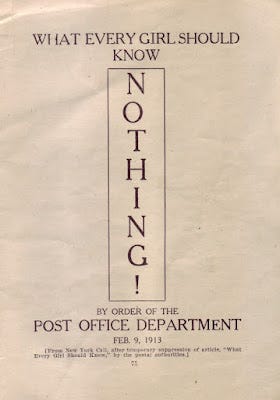
Project 2025 explicitly calls to use the Comstock Act to block access to both abortion pills and medical equipment used for abortion care — which would effectively ban abortion in all 50 states, bypassing Congress and the courts entirely. Reproductive Freedom for All
The connection to Sally Mann isn’t incidental. The same ideological infrastructure that wants to criminalize mailing mifepristone is the one that walked into a museum and removed photographs from a show about women’s lives. Both moves use the language of moral protection — children, family, God’s law — to suppress women’s expression and autonomy. Both rely on the threat of prosecution as a tool even when prosecution fails: as Werbel notes, “threatening legal action undoubtedly has a chilling effect.” The Free Speech Center
Let’s be clear about something that often gets lost when these fights are framed purely as reproductive rights issues: the right to access abortion information, to mail medication, to publish health literature, and to make and show art about the human body are all First Amendment questions. The Comstock Act was always an obscenity law — a speech regulation — and its revival is a speech regulation too. When the government criminalizes the mailing of medical information, it is restricting what doctors can say to patients, what advocates can distribute, and what publishers can print. The chilling effect is not a side consequence; it is the point. Suppressing information suppresses action. That is exactly what Comstock understood in 1873, and what the Heritage Foundation understands now. fire
What can be done?
Senator Tina Smith reintroduced the Stop Comstock Act in March 2025, which would repeal the Comstock language that could be used to ban the mailing of medication abortion, surgical instruments, and educational material related to sexual health. The House bill currently has 110 Democratic co-sponsors, and the Senate bill has 23 Democratic co-sponsors. With Republican majorities in both chambers, passage is not imminent — but the legislation establishes a clear repeal position and creates political accountability. The fight to remove this law from the books is a long game. Senator Tina Smith
In the shorter term: support organizations actively litigating these cases — ACLU, FIRE, NCAC. Follow what happens to mifepristone access. Pay attention to museum programming in red states. And remember that Comstock’s original targets were women who spoke publicly about their bodies, their rights, and their autonomy. The continuity is not coincidental.
Another Federal Book Ban Attempt – H.R. 7661
On February 24, 2026 — the same evening as President Trump’s State of the Union, in which he called for an immediate national ban on gender identity policies in schools, Illinois Representative Mary Miller introduced H.R. 7661, the “Stop the Sexualization of Children Act.” The timing was coordinated, not coincidental. The bill currently has 17 Republican co-sponsors and sits in the House Committee on Education and Workforce. It has not yet advanced — but it doesn’t need to pass to do damage.
H.R. 7661 doesn’t create a new federal crime. It does something subtler: it proposes to amend the Elementary and Secondary Education Act of 1965, the main federal education funding law that funnels billions of dollars annually to states and school districts. Any school using materials the bill defines as “sexually oriented” would lose that funding.
The definition is where the agenda becomes clear. It covers not only works depicting sexually explicit conduct, but also works that “involve gender dysphoria or transgenderism” — meaning books featuring transgender characters would be barred from federally funded school programs even if they contain no sexually explicit content whatsoever. The Authors Guild
The bill exempts “classic works of literature” — but defines them by outsourcing the judgment to fixed lists, including The Great Books of the Western World, a 35-year-old collection built almost exclusively around works by white European and American men. This is not a neutral literary standard. It is a vision of whose stories belong in American schools.
The response from library, literary, and civil liberties organizations has been swift. American Library Association (ALA) president Sam Helmick stated, “H.R. 7661 isn’t fundamentally about protecting kids. It’s about giving politicians broad authority to restrict whose stories are allowed on our shelves.” PEN America called it “an overt, intentional dog whistle” targeting LGBTQ+ students and their stories. The Authors Guild, representing more than 17,000 working writers, called the bill “a federal attack on free expression in schools.” EveryLibrary warned that targeting gender and sexual minorities is typically the first move in a broader campaign that quickly extends to race and religion.
This bill represents the federalization of a censorship strategy that has until now operated at the state level. 2025 was already a record year for education censorship — more than half of U.S. college and university students now study in a state with at least one law restricting what can be taught. H.R. 7661 attempts to bring that logic to every federally funded school simultaneously.
What you can do
Call Congress at 202-224-3121 and ask your representative to oppose H.R. 7661. Find your representative at House.gov. As a counterproposal, advocates are pointing to the Right to Read Act, which invests in school libraries rather than defunding them. The American Library Association, PEN America, EveryLibrary, and the Authors Guild all have active action alerts.
The Bully Pulpit has Limits
Last December, Florida Governor Ron DeSantis signed an executive order unilaterally designating the Council on American-Islamic Relations — CAIR, one of the largest Muslim civil rights organizations in America — as a foreign terrorist organization, and directed state and local agencies to deny the group contracts, employment, funding, and benefits. No trial. No due process. Just a press release with the force of law.
This week, U.S. District Judge Mark Walker blocked it. In a thirty-page ruling, he accused DeSantis of choosing “political posturing over the First Amendment” and called it part of a “troubling trend” of using the executive office to make political statements at the expense of constitutional rights.
The ruling is notable for what it refuses to do: it doesn’t pretend the political context doesn’t exist. Walker wrote plainly that “it is often minority religious groups who find themselves in the crosshairs” and that the Muslim community is “an especially easy target” in Florida, where they make up less than one percent of the population.
The real-world impact was already visible. A production company pulled out of a podcast agreement with CAIR after the order was signed. When a Muslim conference was scheduled at a Coral Springs arts center, the state Attorney General publicly put the city “on notice.”
The judge named it: “Plaintiff has been publicly designated a terrorist organization from Florida’s bully pulpit and continues to suffer for it.” arcamax
Suing for Speech
The lawsuit has become the primary tool of democratic survival. JustSecurity.org is tracking over 670 lawsuits against the Trump administration, with plaintiffs leading the government 223 to 111. Among them, a significant cluster targets something FACT cares about directly: the systematic use of government power to suppress, punish, and chill speech. thebulwark
The watchdog group Citizens for Responsibility and Ethics in Washington (CREW) has been in the thick of it since Inauguration Day. But it’s their transparency work that most directly touches First Amendment terrain. CREW sued the Trump administration over the closure of the CDC’s entire FOIA office — seeking records on DOGE’s involvement and on a suppressed expert assessment about measles vaccination. They also filed FOIA requests targeting Customs and Border Protection’s use of Predator drones to surveil First Amendment-protected protest activity — after CBP confirmed it was flying surveillance drones over Los Angeles immigration protests in July 2025. When the government destroys FOIA infrastructure or uses military surveillance against demonstrators, access to information and the right to protest don’t just feel threatened — they are threatened. InfluenceWatch
The arts and humanities have been a particular battleground. In July 2025, a federal judge issued a preliminary injunction blocking the mass cancellation of National Endowment for the Humanities grants, ruling that the administration had terminated grants “based on the recipients’ perceived viewpoint, in an effort to drive such views out of the marketplace of ideas.” The judge was explicit: “Agency discretion does not include discretion to violate the First Amendment. Nor does it give the Government the right to edit history.” Chicago Tribune
Meanwhile, the NEA has been turned into an instrument of ideological gatekeeping. The ACLU sued the NEA over a new requirement that all grant applicants certify that federal funds would not be used to “promote gender ideology” — a viewpoint-based restriction that, as ACLU attorneys put it, amounts to a loyalty oath. “Grants from the NEA are supposed to be about one thing: artistic excellence. Blocking eligibility for artists because they express a message the government doesn’t like runs directly counter to the First Amendment’s prohibition on viewpoint-based regulation.” ACLU
Press freedom is under coordinated assault. The U.S. now ranks 57th out of 180 countries on the World Press Freedom Index — its lowest ranking since the index began in 2002. Poynter documented 76 federal actions against journalists in 2025, and 13 lawsuits have been filed by journalists and media organizations against the Trump administration for press freedom violations. Trump limited AP’s press access after it refused to rename the Gulf of Mexico, extracted settlements from ABC and CBS, and is currently suing both the New York Times and Wall Street Journal. The Free Speech Center
The pattern across all of these cases is identical to what we’ve covered elsewhere in this newsletter — NewsGuard, Media Matters, CAIR: government using its regulatory and financial leverage not to enforce law, but to punish speech it dislikes. The mechanism shifts — a drone, a canceled grant, a merger condition, a revoked press pass — but the constitutional violation is the same.
Courts are holding some of these lines. Not all of them. And as the Knight First Amendment Institute has noted, the regulatory leverage a motivated executive can exert — from FCC oversight to NIH funding to immigration enforcement — can be so vast and ongoing that litigation alone is unlikely to be sufficient. Knight First Amendment Institute
The FTC Speech Police
There’s a pattern forming, and it deserves naming. In May 2025, the FTC targeted NewsGuard — a media reliability organization that rates news sources based on journalistic standards — with a sweeping 21-page subpoena demanding documents related to its ratings, the identities of all its customers, reporter notes, sources, and financial records going back to January 2018. Courthouse News Service
Why? Conservative outlets like Newsmax and One America News Network — favorites of President Trump — had received low ratings. OAN scored 22.5 out of 100. They complained an the FTC took upo the mission.
NewsGuard’s legal team, led by Robert Corn-Revere of the Foundation for Individual Rights and Expression, put it plainly in their lawsuit: “The FTC is brazenly using its power not for any issue concerning trade or commerce, but rather to censor speech — simply out of disagreement with NewsGuard’s journalistic judgments about the reliability of news sources.” Deadline
The retaliation has teeth. Beyond the subpoena, the FTC imposed a condition on the merger of Omnicom Group and The Interpublic Group — two of the largest media buying companies in the world — literally prohibiting them from contracting with NewsGuard or using its rating services. That’s a blacklist.
NewsGuard tried to comply, turning over more than 40,000 pages of documents. They showed the FTC that their market share in advertiser brand safety tools was less than 0.1% — making any antitrust rationale absurd on its face. And still the demands kept coming, now targeting their customer list, which, as their lawyers noted, “tends to scare them off.” Courthouse News Service
This week, a federal judge heard arguments on NewsGuard’s bid for a preliminary injunction. Judge Dabney Friedrich, a Trump appointee, expressed skepticism — not about whether the FTC had overreached, but about whether the subpoena itself constituted a challengeable enforcement action and whether the harm was “irreparable” in the legal sense.
The legal ground here is not new. In August 2025, a different D.C. district judge blocked an essentially identical FTC demand against Media Matters, writing that “it should alarm all Americans when the Government retaliates against individuals or organizations for engaging in constitutionally protected public debate” — and that the alarm “should ring even louder when the Government retaliates against those engaged in newsgathering and reporting.” Wiggin and Dana LLP
The D.C. Circuit already ruled in the Media Matters case that the FTC’s investigation constituted “a government campaign of retaliation” infringing First Amendment rights. NewsGuard’s case follows the same playbook almost point for point.
FTC Chairman Andrew Ferguson had laid out exactly what he intended to do — before he was even confirmed. In an April 2025 interview, he explained how the FTC could use its “tremendous array of investigative tools” and “coercive power — formal and informal” to demand compliance with its views about online “censorship.” Techdirt
The recent court case, Vullo v. National Rifle Association, arose from a 2018 move by Maria Vullo, then superintendent of the New York Department of Financial Services, who pressured banks and insurance companies to cut ties with the NRA following the Parkland shooting. She didn’t pass a law or issue a formal order — she just made clear, through meetings and guidance letters, that regulators would look favorably on institutions that distanced themselves from the NRA and unfavorably on those that didn’t.
The NRA sued, arguing this was unconstitutional government coercion of private parties to suppress speech. The Supreme Court ruled unanimously in 2024 that even informal government pressure — no explicit order required — can violate the First Amendment if officials are leveraging their regulatory authority to punish or suppress viewpoints they dislike. Using merger conditions to blacklist a company because you disagree with its journalism is a textbook example.
What’s at stake isn’t just NewsGuard’s survival. It’s the principle that independent journalism and media criticism can exist without government approval. Rating systems, fact-checkers, watchdog organizations — all are now on notice that if their conclusions displease powerful figures, regulatory machinery can be turned against them. Not to find wrongdoing. To make the work too expensive to continue.
Worth the Trip to Philadelphia: The Forgotten Freedom Opens This Week
The National Liberty Museum in Philadelphia opens The Forgotten Freedom: American Assembly at 250 this Friday, March 6 — a three-part exhibition series timed to the nation’s 250th anniversary and focused on one of the First Amendment’s least discussed rights: the freedom of assembly.
It’s an ever-timely subject. While speech and press dominate the current conversation about civil liberties, the right to peaceably assemble — to gather, organize, march, associate, and build collective power — is the mechanism through which most of those other freedoms have actually been exercised. The museum’s choice to center assembly feels less like historical commemoration than active argument.
The series spans three interconnected exhibitions. Showing Up Since 1776 traces the history of assembly as a civic force, from colonial taverns and Quaker meeting houses through labor organizing, protest marches, concert halls, and sports arenas. Artifacts range from an AFL/AFT-CIO strike vest and campaign pins to a Taylor Swift fan jacket — a span that makes a point about what “assembly” actually encompasses in American life.
In the Arena extends that argument into sports, examining stadiums and athletic events as assembly spaces with their own political histories. And The Art of Free Assembly brings in contemporary artists from across the country to explore gathering as both instinct and civic practice — among them Beau McCall, whose button-sewn works are held by the Philadelphia Museum of Art and the V&A; Zsudayka Nzinga, whose research-based textile work on Black labor history is in the permanent collection of the National Civil Rights Museum; and Brooklyn-based Meridith McNeal and the ART YARD BKLYN collective.
The National Liberty Museum is at 321 Chestnut Street in Old City Philadelphia, open Wednesday through Monday, 10 am to 5 pm. Admission is $12 for adults, free for members.
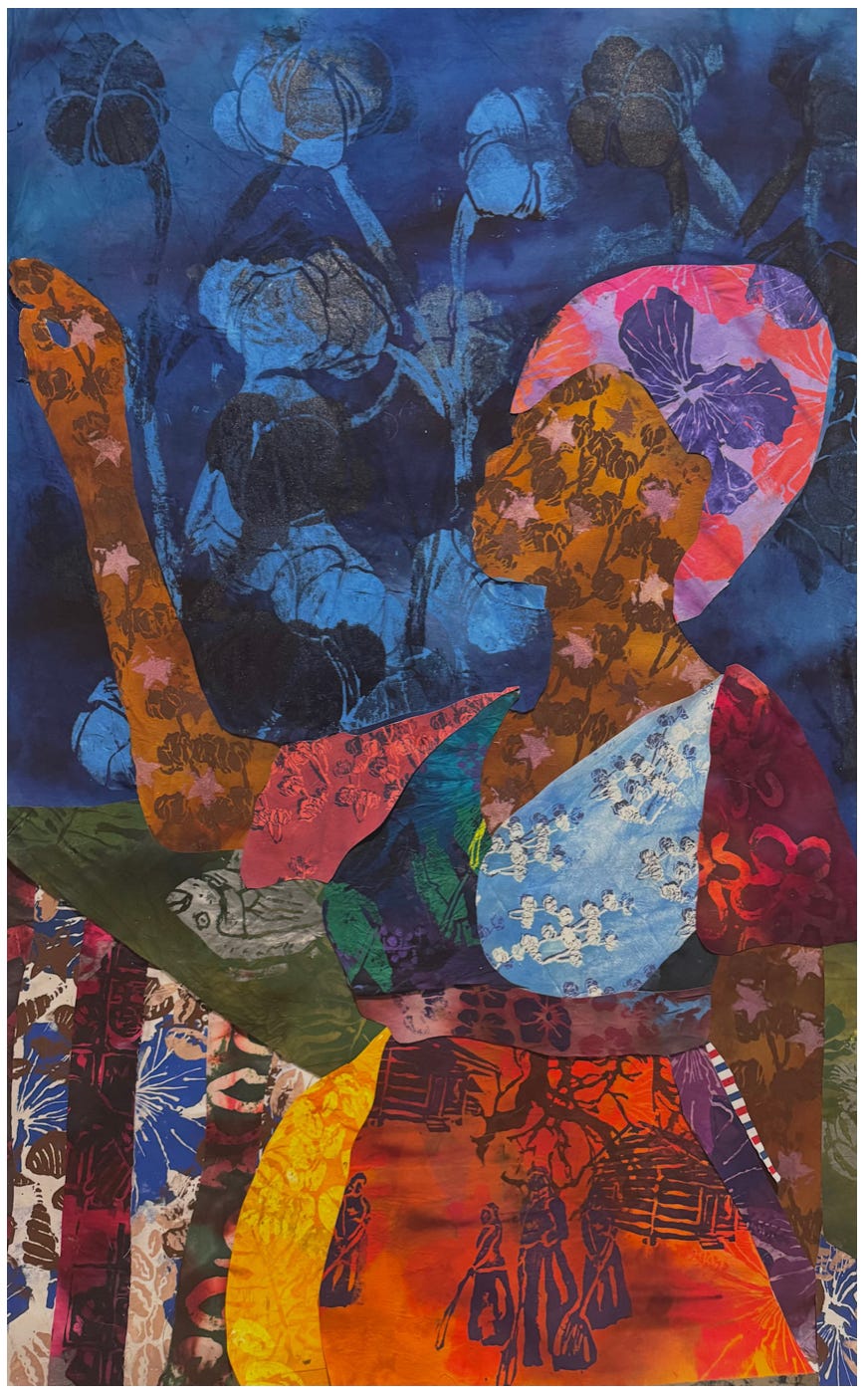
From one of the exhibiting artists, Zsudayka Nzinga’s Instagram, “I’ve noticed over the last few years of my studies and discussions, that we talk about Freedom like it’s an object. Like it’s a thing that gets distributed or has to be taken and held tightly too. Or we talk about Freedom like it’s a destination. Like you get there and you can FEEL it, somehow. Harriet Tubman said her first moments of freedom were her saddest and most lonely, realizing all she had left behind. That loneliness is what drove her back to get her family. I’ve read similar sentiments from so many people who ran away and then returned because they missed their people. The freedom didn’t feel like what they imagined, it wasn’t as easy to hold and contain.
This painting reexamines the American flag as a mode of physical and mental transport. The American experience is really a cycle of passages and migrations, a movement between north and south and a flickering burst west. It flips the stripes to the bottom and posits the blue as just beyond the river. The stars are in the skin of the figure, also composed of cotton which repeats though her dress. The women she leaves behind dance across her smock, a reminder of her role at “home”. The laborers wrap around her, defining her. But she is alone. Sitting in the moment right before she “finds” the freedom she’s been searching for.”
Call to Action - Sign This for a Free Press
Last week, Warner Bros. Discovery accepted a $111 billion takeover bid from Paramount Skydance — and the implications for press freedom are serious. The deal would place CBS, CNN, and a vast entertainment empire under the control of the Ellison family, with Larry Ellison — Oracle billionaire and Trump adviser — helping finance the acquisition. David Ellison had already signaled his intentions: according to the Wall Street Journal, he offered assurances to Trump administration officials that if he bought Warner, he'd make sweeping changes to CNN.
The deal is also reportedly backed by sovereign wealth funds from Saudi Arabia, Qatar, and Abu Dhabi — raising legitimate questions about how those financial ties will shape coverage of Middle East conflicts at both CBS and CNN. This isn't just a business story. It's a First Amendment story — about who controls the newsrooms that shape what Americans see and hear, and whether that control is being handed to people with a political agenda.
The merger still requires regulatory approval, and state attorneys general have the power to intervene. Free Press is asking you to tell them to use it.
Testify
Enjoy this testimony from comedy writer and author of “Buffalo Fluffalo" Bess Kalb before the House Judiciary Committee for a panel on threats to free expression under the Trump Administration.
Acknowledgement
We are always grateful for the encouragement and suggestions of our colleagues and peers.
NEXT STEPS: TAKE ACTION
First Amendment Friday
F.A.C.T. invites all cultural institutions, artists, and activists to post First Amendment stories, graphics, calls to action, and advice to their audience every Friday. Join our campaign by signing up here. Feel free to use our digital assets here.
Public Practice
We are asking cultural venues in New York City (and across the USA) to prominently place our First Amendment poster in their public areas. Sign up to get your copy. We are also asking performance venues to share our curtain speech (or create your own).