
First Amendment Friday
February 20, 2026
Digital Blackface: Weaponizing Racist Free Speech
The First Amendment was designed as a shield — protecting individuals from government overreach, guaranteeing the right to dissent, to protest, to speak truth to power.
When the official White House X account posted a doctored, deliberately darkened image of Minnesota activist Nekima Levy Armstrong — arrested at a peaceful anti-ICE demonstration — it wasn’t just ugly politics as usual. It was state-sponsored disinformation targeting a private citizen engaged in constitutionally protected activity. Section 230 immunity doesn’t apply to government accounts. No platform algorithm shoulders the blame. That’s the state itself bending reality to intimidate and suppress lawful dissent. Shortly after, Trump’s Truth Social account circulated an image portraying the Obamas as apes. Trump disclaimed responsibility and declined to apologize.
This is the new minstrelsy — and it has a legal architecture protecting it.
AI-generated “digital blackface” has exploded in the past two years as generative video tools became widely accessible. Fake videos depicting Black women selling food stamps, deepfakes of MLK shoplifting or wrestling Malcolm X, AI avatars built on scraped Black voices and likenesses — all designed to inflame racist narratives, launder bigotry as viral content, and flood the zone with disinformation. Platforms like TikTok, Instagram and X remain largely untouchable under Section 230 of the Communications Decency Act, the 1996 law that immunizes platforms from liability for third-party content. Section 230 was designed to let the internet scale without companies being sued into oblivion for every user post. In practice it has become a liability-free zone for some of the most targeted harassment and disinformation in American history.
The First Amendment itself offers limited remedy. Under the Brandenburg v. Ohio standard — established by the Supreme Court in 1969 — speech is only unprotected when it is directed toward producing imminent lawless action and is likely to actually produce it. “I hate X people” is constitutionally protected. “Go hurt that specific person right now” is not. The bar is deliberately high — the Brandenburg standard exists to prevent government from criminalizing political dissent. But it also means that AI-generated content designed to humiliate, dehumanize and endanger real people exists in a legal gray zone where defamation claims are difficult, hate crime statutes require a physical act, and 230 reform remains perpetually stalled in Congress.
The gap between harm and recourse is where the damage lives. UCLA professor Safiya Umoja Noble puts it plainly: “We are living in a United States with an open, no-holds-barred, anti-civil-rights, anti-immigrant, anti-Black, anti-LGBTQ, anti-poor-policy agenda. Finding the material to support this position is just a matter of the state bending reality to fit its imperatives.”
The First Amendment was built to protect individuals from government power. What we’re watching now is government learning to use that same constitutional architecture — platform immunity, high incitement thresholds, AI-generated plausible deniability — as instruments of suppression. The shield has become the weapon. And the people absorbing the blows are exactly the ones the amendment was meant to protect.
Neither From Here Nor There
When the University of North Texas, a public research university, abruptly shuttered “Ni de Aquí, Ni de Allá,” an exhibition by Boston University-based artist (and my former neighbor) Victor “Marka27” Quiñonez, it didn’t bother to tell the artist first. Quiñonez learned his show had been covered and closed through messages from UNT students on social media. Days later, he received a four-line email from the gallery director. No explanation. No prior notice. The university has since officially terminated the loan agreement and is arranging to return the work to Boston University.
The exhibition — whose title translates as “neither from here nor from there” — opened February 3 and was scheduled to run through May 1. Quiñonez’s practice centers on the lived experience of immigrants in the United States and their treatment by federal agencies, including ICE. The timing of the closure, amid escalating federal immigration enforcement and a chilling political climate on campuses, raises questions the university has so far declined to answer publicly.
This is a First Amendment story, and a familiar one. Public universities are state actors — they are directly bound by the First Amendment in ways private institutions are not. The suppression of artwork based on its political viewpoint is textbook viewpoint discrimination, which the Supreme Court has repeatedly held unconstitutional. Quiñonez says he plans to keep pressing the university for answers.
What’s at stake isn’t just one exhibition. When universities preemptively pull work that speaks to immigrant (or any other identity-specific) experience — without explanation, without notice, apparently without even the courtesy of a conversation with the artist — they signal to every student, faculty member, and visiting artist exactly what speech is now considered dangerous. That signal is the suppression. You don’t need a formal policy. You just need people to get the message.
“Ni de Aquí, Ni de Allá.” Neither from here nor from there. In trying to make this work disappear, UNT may have given it the most resonant title imaginable.
Update: History Fights Back
Recently, we wrote about the Trump administration’s systematic erasure of history from national parks and federal sites. Here’s a positive update from Philadelphia.
The National Park Service, acting under Trump’s executive order prohibiting exhibits that “inappropriately disparage Americans past or living,” removed the slavery memorial panels from the President’s House in Philadelphia — the site where George Washington enslaved nine people, including children. The exhibit, “Freedom and Slavery in the Making of a New Nation,” took activists eight years of organizing to achieve. It opened in 2010 as the first slavery memorial of its kind on federal property. It was gone within weeks of the executive order earlier this year.
The city of Philadelphia sued. More than 200 activists rallied. And this week, U.S. District Judge Cynthia Rufe granted a preliminary injunction ordering the panels restored — calling the removal so Orwellian she opened her ruling with a quote from 1984: “All history was a palimpsest, scraped clean and reinscribed exactly as often as was necessary.”
Workers began restoring the exhibit this week. The Trump administration, meanwhile, has already filed an appeal.
The federal government argued in court that removing the panels was simply its right to control its own message — invoking government speech doctrine as justification for disappearing inconvenient history. The First Amendment does not allow the government to control speech (or history) on public property. The judge wasn’t buying it, and neither are we.
Who Controls the Constitution Center?
A short distance from Independence Mall, another constitutional ‘battle’ is being waged. At the National Constitution Center in Philadelphia, Jeffrey Rosen, the legal scholar who spent 12 years building the NCC into the country’s premier nonpartisan forum for constitutional debate, has been forced out — and according to retired federal judge J. Michael Luttig, a prominent conservative Trump critic who resigned from the board in protest, the ouster was about one thing: the 250th anniversary of America’s founding and who gets to control the narrative around it.
“The two chairmen’s reprehensible actions were all about Donald Trump and the celebration of the 250th anniversary,” Luttig told the Guardian. The board meeting that sealed Rosen’s fate lasted hours; he was blocked from even speaking to members in his own defense.
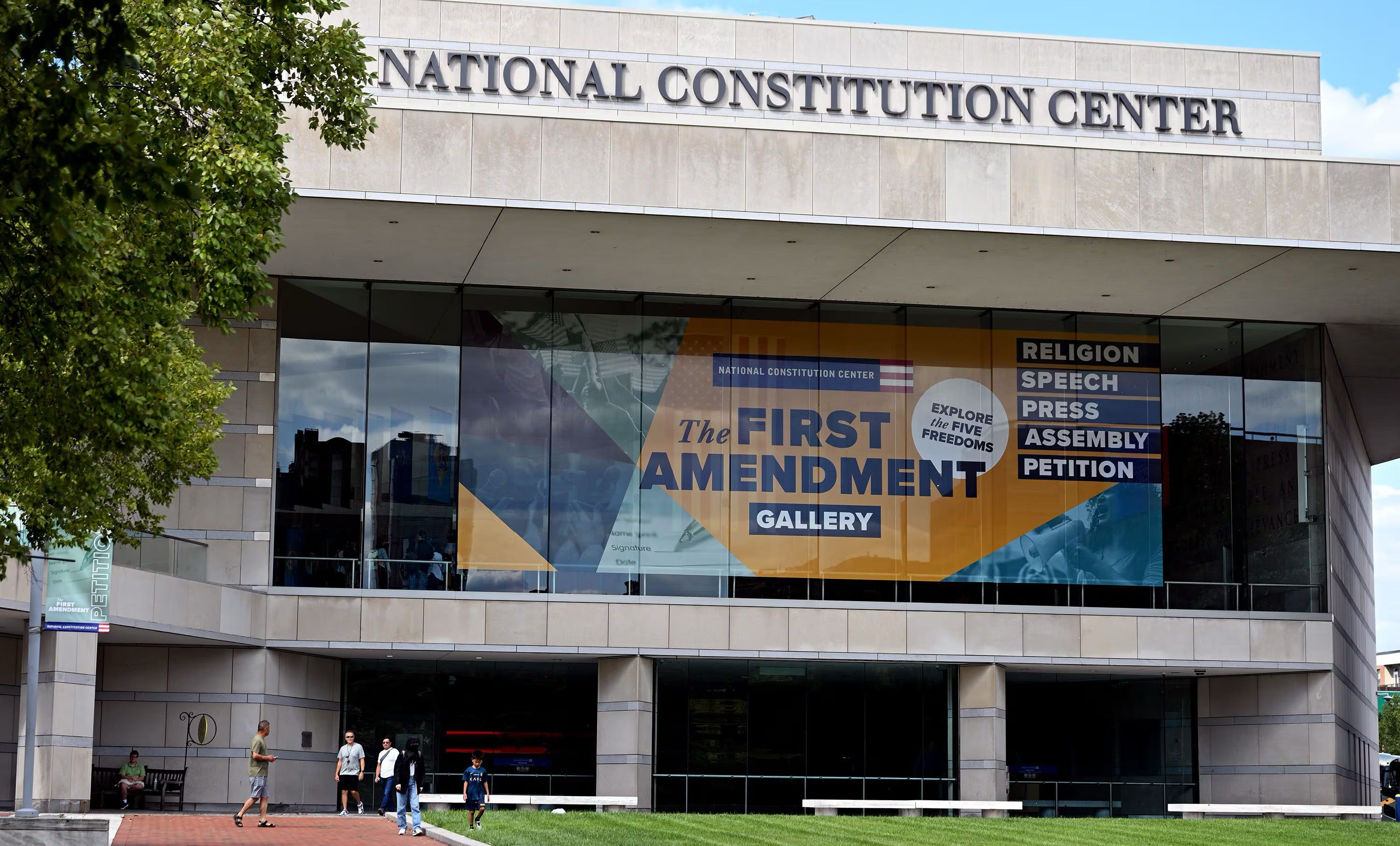
The pattern is familiar. Trump has installed himself at the Kennedy Center, renamed it, and watched ticket sales crater. He’s demanded the Smithsonian purge “woke” content. He’s pressured the NEA. Now, the National Constitution Center, chartered by Congress specifically to operate on a nonpartisan basis, is the theater for Trump’s war on the Constitution. The institution literally has a 50-ton marble First Amendment tablet in its atrium.
The First Amendment protects speech from government suppression. It does not, technically, prevent a president from quietly reshaping the boards of cultural institutions to reflect his preferred version of American history. When the building that houses the Constitution becomes a political trophy and an opportunity to rewrite history, something profound is being lost.
The Body is the Medium and the Message
On President’s Day, 22 dancers gathered in Washington, D.C. to perform “ResistDance” — first on the steps of the Lincoln Memorial, then inside the Kennedy Center, in a guerrilla action that lasted seconds before being shut down by 23 officers - more cops than dancers.
The piece was created by the First Amendment Troop, the advocacy arm of Hungryman Productions, directed by two-time Academy Award nominee Bryan Buckley and choreographed by Tony Award-winning Matthew Steffens, with dancers from Broadway productions including Hamilton, MJ, and Wicked. The number 22 was deliberate — it represents the days between the deaths of Renée Good and Alex Pretti, two people killed during ICE operations. The music was Rhiannon Giddens. The performance coincided with the FBI’s denial of access to information in the Pretti investigation.
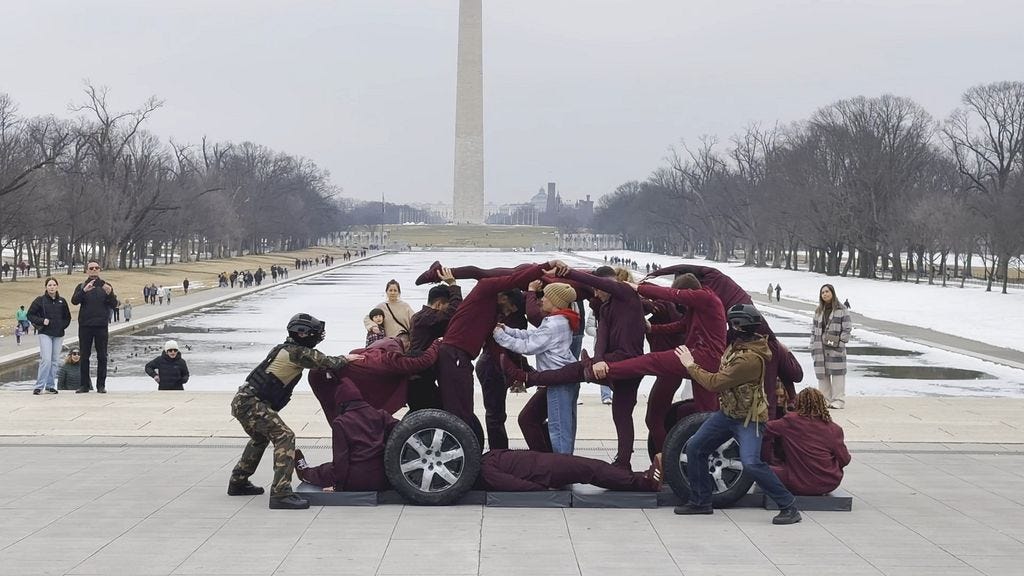
The Lincoln Memorial performance was peaceful and unimpeded. The Kennedy (not Trump) Center was a different story.
This is exactly what the First Amendment was designed to protect: expressive assembly in public spaces, artistic dissent, and the body as political speech. The immediate suppression at the Kennedy Center, outnumbered and outgunned in under a minute, is its own kind of statement about what that institution has become.
What Is Art at the Border?
When Trump’s sweeping tariffs hit imported goods in 2025, original artworks were officially exempt — not as a trade courtesy but as a constitutional matter. The 1988 Berman Amendment explicitly protects expressive works from import restrictions, grounded in the First Amendment principle that the government can’t erect economic barriers around protected speech. Paintings, sculpture, prints: duty-free by law.
But that protection only covers objects. It says nothing about the artists themselves.
While a canvas can cross a border under constitutional protection, the painter who made it may not be able to follow. Performing artists — musicians, dancers, theater makers — depend entirely on visa access to work in the U.S.and present their art. Those visas, particularly the O-1 and P categories, are discretionary, slow, expensive, and increasingly subject to political pressure. No Berman Amendment protects a choreographer’s ability to enter the country. No First Amendment exemption covers a touring theater company stuck at immigration.
The inconsistency is striking. A recorded performance ships duty-free as informational material. The live version of the same work can be blocked entirely if the artist can’t get a visa. The object is protected; the human who makes the object is not.
It raises a question the law hasn’t fully answered: if the First Amendment protects artistic expression as speech, does that protection extend only to the artifact — the thing that can be crated and shipped — or to the act of creation itself? Performance art, by definition, can’t be separated from the body that performs it. Restrict the artist’s movement, and you restrict the work. There’s no import exemption for that.
The Supreme Court will weigh in on tariff authority by June 2026. The visa question won’t be on the docket.
Lee Bollinger’s First Amendment Moment
Lee Bollinger has spent his career as one of America’s most prominent First Amendment scholars — first as president of the University of Michigan, then for two decades at Columbia, and now as a Columbia Law professor whose January 2026 book, University: A Reckoning, argues that academic freedom must be understood as constitutionally essential, as fundamental to the First Amendment as freedom of the press. In a recent conversation with Brian Lehrer on WNYC, Bollinger brought that argument to bear on a university landscape under extraordinary pressure — federal funding threats, political interference, and a systematic assault on campus speech that would have seemed unthinkable a decade ago.
It’s worth listening to. It’s also worth asking a harder question.
Bollinger’s thesis is compelling: universities don’t just benefit from the First Amendment, they embody it. The pursuit of knowledge, the tolerance of uncomfortable ideas, the protection of dissent — these aren’t institutional courtesies, they’re constitutional obligations. In the current climate, with the Trump administration using funding as a weapon against universities that don’t conform to its political preferences, Bollinger’s framework gives advocates real legal and moral ground to stand on.
But Bollinger was president of Columbia from 2002 to 2023. And Columbia’s record on student First Amendment rights during that period is, to put it charitably, complicated.
In spring 2024, Columbia became the flashpoint of the national campus protest movement over Gaza. Students erected encampments. The administration called in the NYPD twice. Hundreds of students were arrested, and many were suspended. The university’s handling of pro-Palestinian protest drew criticism not just from the left but from civil liberties organizations who noted that the administration’s response was disproportionate and selectively applied. Bollinger had stepped down by then, but the institutional culture he built was very much in evidence.
And it wasn’t just 2024. During Bollinger’s own tenure, Columbia faced recurring criticism over how it handled politically contentious speech — from the 2006 invitation of Iranian President Ahmadinejad, which Bollinger turned into a public rebuke rather than a genuine exchange, to the treatment of faculty whose scholarship touched on Israel-Palestine. The pattern suggested an institution that championed free speech as an abstract principle while managing its application carefully when political or donor pressure was involved.
This may be less hypocrisy than evolution — or liberation. There’s a meaningful difference between what a university president can say and what a scholar freed from trustee accountability can say. Bollinger spent twenty years navigating the institutional pressures that his new book implicitly critiques. It’s possible that University: A Reckoning represents what he actually believed all along, finally said plainly. It’s also possible that responsibility clarifies in retrospect in ways it doesn’t in the moment.
Either way, the argument matters now. The First Amendment case for university independence is one of the strongest tools available against federal overreach into academic life. If Bollinger’s evolution from cautious administrator to outspoken constitutional advocate helps build that case, the timing is welcome — even if the personal history warrants a raised eyebrow.
The question for Columbia, and every university under pressure right now, is whether they’ll treat the First Amendment as a shield for their students and faculty, or continue to wield it selectively, protecting the institution’s interests while managing the speech of the people inside it.
Charlie Kirk’s Free Speech Legacy
Charlie Kirk spent his career as a self-styled champion of free expression, touring college campuses to defend the First Amendment against what he called the suffocating grip of political correctness. When he was assassinated, the response from his supporters became one of the most significant tests of those very principles in recent memory.
Within 24 hours of Kirk’s death in September 2025, a coordinated campaign targeted people who expressed anything less than grief. A website collated names and employers. JD Vance, guest-hosting Kirk’s own podcast, told listeners to “call their employer.” By November, Reuters estimated that 600 people had been fired, suspended, or disciplined for their social media posts — among them a 19-year sheriff’s deputy, a disabled Army veteran, and a teacher’s aide who was fired essentially for quoting Kirk’s own words back.
The First Amendment doesn’t protect private employees from their employers. But most of those targeted worked for government agencies, which means the Constitution does apply. The Foundation for Individual Rights and Expression, which had actually helped Kirk’s organization set up college chapters, immediately began building cases. One Tennessee university already paid a $500,000 settlement for wrongful termination. Lawsuits are multiplying.
The irony is almost too perfect. The movement that weaponized employer pressure against liberal professors and diversity administrators for years found itself on the receiving end of the same tactic — and the civil liberties infrastructure Kirk’s allies helped build is now defending his critics.
NYC Council - Don't Hand Protesters to the NYPD
At a moment when the federal government is actively dismantling First Amendment protections, the New York City Council is considering legislation that would do some of that work locally. Introductions 0001 and 0175, proposed by Council Speaker Julie Menin and Council Member Eric Dinowitz, would create buffer zones restricting protest outside houses of worship and educational facilities. The bills would be enforced at the discretion of the NYPD.
On February 9th, four Jewish organizations — Jews for Racial and Economic Justice, the American Council for Judaism, Jewish Voice for Peace NYC, and IfNotNow NYC — released a joint statement urging the Council to reject both bills. Their argument is worth reading carefully, because it cuts through the framing that’s made these bills politically easy to support.
The bills emerged in response to protests outside New York synagogues — at least one of which was hosting a political event encouraging the sale of Palestinian land in violation of international law. The organizations are clear that people should be able to pray without fear of harassment. But they draw a precise distinction: when a house of worship hosts a political event, it enters the public debate. Protest of that event is protected speech. Criminalizing it because the building has a religious designation is a different matter entirely.
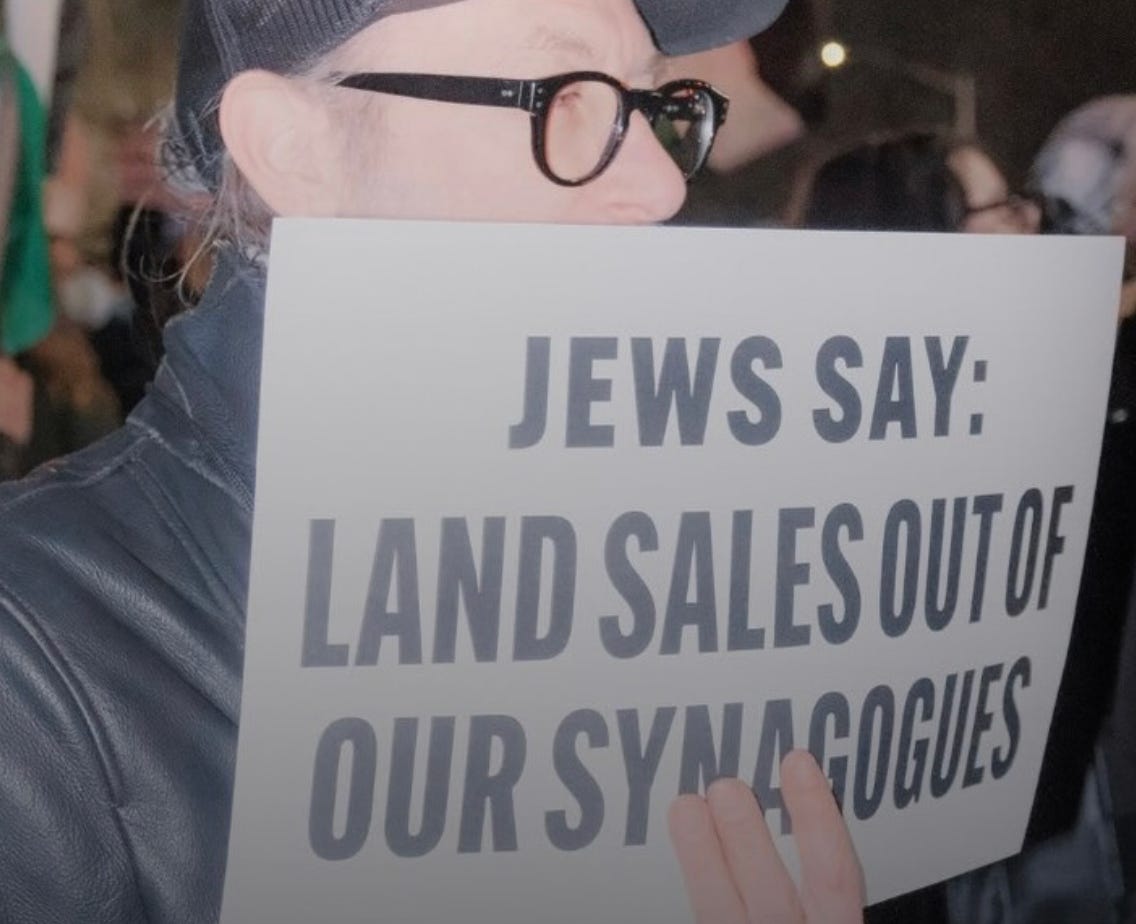
The deeper concern is what these laws become in other hands. The groups point to the Trump administration’s use of the FACE Act — originally passed to protect abortion clinic access — as a tool to prosecute journalists and activists. Buffer zone legislation, passed with good intentions in a relatively liberal city, becomes an infrastructure available to anyone in power. That includes an NYPD with a documented history of illegal surveillance of Muslim communities, unconstitutional kettling of protesters, and racially discriminatory enforcement.
The statement’s core argument is a First Amendment one: strong, open democracy protects Jewish communities better than restrictions on dissent. New York’s tradition of pluralism and protest — including Jewish protest traditions going back generations — is not a threat to Jewish safety. Legislation that narrows the space for dissent, at this particular moment, is.
The City Council should listen.
Destroying the New Deal
When Franklin Roosevelt commissioned nearly 1,700 murals for post offices across America in the 1930s, the federal government became the largest patron of public art in the country’s history. It also became the owner. And ownership, it turns out, comes with very few strings attached when the owner is the state.
A Washington Post investigation recently documented what’s happened to that collection: nearly 200 murals are simply missing. Dozens more have been destroyed, painted over, or quietly transferred out of public view. Many were covered precisely because their content, depictions of Black labor, Indigenous communities, and immigrant life, made someone uncomfortable. No explanation required. No public process. Just paint over it and move on.
The obvious legal question is whether the Visual Artists Rights Act — VARA — protects these works. The short answer is almost certainly not. VARA, passed in 1990, protects artists’ integrity rights in works of “recognized stature,” including the right to prevent destruction. But it applies only to works created after 1990, or pre-1990 works where the title hadn’t been transferred. The New Deal murals were commissioned works — title transferred to the federal government at creation, decades before VARA existed. The law that might protect them simply arrived too late.
What does apply is a patchwork of federal preservation statutes that create procedural obligations without hard prohibitions. The USPS has a legal duty to preserve these works. But as the Post’s reporting makes clear, duty and practice have long since parted ways, and enforcement mechanisms are weak.
The deeper legal framework is what First Amendment attorney Douglas Mirell calls the government speech doctrine — and it cuts in uncomfortable directions here. When the government commissions and owns expressive work, courts have generally held that it can control that work’s display and messaging. The government doesn’t have to show art it dislikes. But Mirell also notes the limits: when government suppresses art based on viewpoint or political pressure — as when Giuliani tried to defund the Brooklyn Museum over Chris Ofili’s work — courts have found First Amendment violations. The line between curatorial discretion and viewpoint discrimination is real, even if it’s hard to enforce.
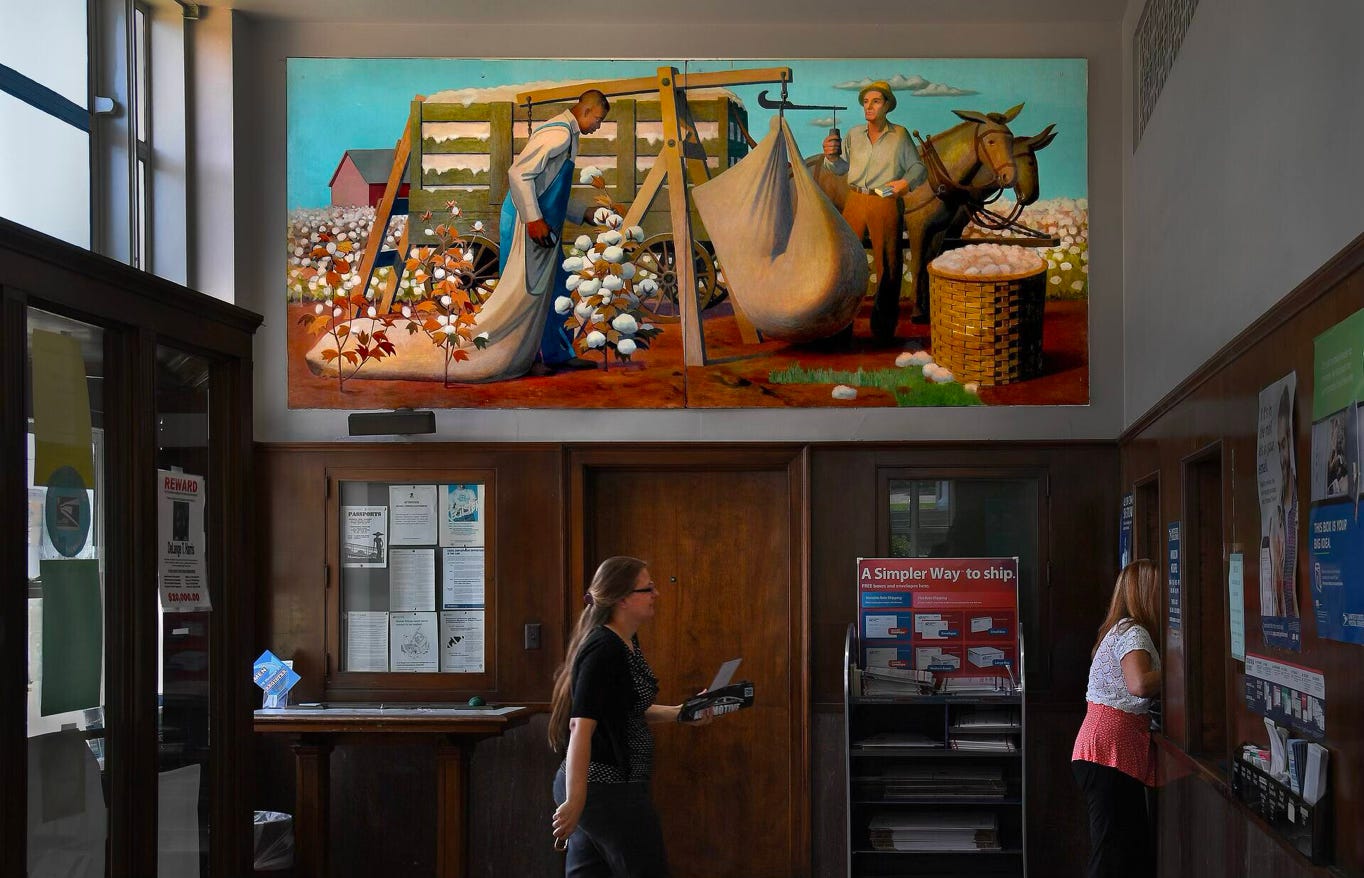
What the New Deal murals represent is something the law hasn’t fully reckoned with: publicly commissioned art, paid for by taxpayers, placed deliberately in democratic public spaces, now disappearing without accountability. The same administration that strips slavery exhibits from national parks, defunds cultural institutions, and scrubs “woke” content from federal spaces is the steward of hundreds of murals depicting Black workers and Indigenous communities.
Roosevelt’s theory was that democracy needs beauty, and that beauty belongs to everyone. VARA can’t protect these works. Preservation law hasn’t. What’s left is the argument — not yet fully tested in court — that the public has a legitimate claim to cultural expression commissioned in their name, installed in spaces built for their use, and currently being managed out of existence one painted-over wall at a time.
When the government commissions art explicitly for public spaces using public funds, it isn’t just exercising government speech — it’s creating a public expressive commons. The post office murals weren’t made to express the government’s views. They were made to reflect, celebrate, and give voice to American communities — their labor, their landscapes, their history. The commissioning intent was democratic and outward-facing, not governmental and self-referential. That’s a meaningful distinction that current government speech doctrine doesn’t fully account for.
The problem is that the Supreme Court’s government speech doctrine, as it currently stands, doesn’t really recognize a category of “public speech” that belongs to citizens rather than the state. Once the government owns the work, it controls the work. The Court has been expanding government speech doctrine in ways that make this harder, not easier — the Pleasant Grove v. Summum decision (2009) essentially said that permanent monuments in public parks are government speech regardless of who created them.
The murals were made for everyone. So is the fight to keep them.
Acknowledgement
We are always grateful for the encouragement and suggestions of our colleagues and peers.
NEXT STEPS: TAKE ACTION
First Amendment Friday
F.A.C.T. invites all cultural institutions, artists, and activists to post First Amendment stories, graphics, calls to action, and advice to their audience every Friday. Join our campaign by signing up here. Feel free to use our digital assets here.
Public Practice
We are asking cultural venues in New York City (and across the USA) to prominently place our First Amendment poster in their public areas. Sign up to get your copy. We are also asking performance venues to share our curtain speech (or create your own).