
First Amendment Friday
March 13, 2026
The Next Hero Might Already Be Here
Rebecca Solnit has a way of reorienting your thinking so quietly you don’t notice it happening until you’re already somewhere new.
In this recent interview, she does it again — this time around the question of political leadership and resistance. When asked why no single figure has emerged as the definitive counter to Trump and Trumpism, Solnit reaches for something Thich Nhat Hanh said near the end of his life: the next Buddha will be the Sangha — the community of practitioners. Not a savior. The community itself.
It’s a framework that cuts against every muscly-guy-in-spandex story we’ve been trained to tell about how change happens. What happened in Minneapolis, LA, Chicago, and throughout our country over the past year has been a story of community rising against fascism. Leadership is important, and the voices that galvanize us into action are essential, but communal action is the hero. That’s worth sitting with, especially right now.
For those of us in the First Amendment space, this lands with particular weight. The rights enshrined in the First Amendment — speech, assembly, petition, press, religion — are structurally communal. They’re not designed for heroes. They’re designed for us. The freedom to gather, to speak both individually and collectively, to demand redress — these are tools built for exactly the kind of distributed, unglamorous, often female-coded organizing that Solnit describes as the actual engine of change.
Solnit also offers something that functions as a kind of diagnostic: despair and amnesia go together. And so do hope and memory.
That is, more or less, why FACT exists — to keep the memory of what these rights mean and what they cost, alive and usable.
Watch the full interview. It’s worth your time.
When Fiction Becomes a Death Sentence
The idea that art corrupts — that violent or transgressive expression is evidence of a dangerous mind — has a long American history. In 1954, psychiatrist Fredric Wertham testified before Congress that comic books were causing juvenile delinquency, leading to industry censorship and the Comics Code Authority. In 1985, Tipper Gore and the Parents Music Resource Center brought Senate hearings targeting heavy metal and rap lyrics, producing the now-iconic Parental Advisory label and a national debate about where creativity ends and criminal influence begins. In each case, the art was treated as a gateway to anti-social or criminal behavior, and its creators as suspects.
Rap has absorbed the lion’s share of that suspicion. Since the early 1990s — when NWA’s Straight Outta Compton drew FBI scrutiny and Ice-T’s “Cop Killer” prompted calls for criminal prosecution — prosecutors have used rap lyrics as courtroom evidence. A 2014 study published in the University of Missouri-Kansas City Law Review found that defendants whose rap lyrics were introduced as evidence were convicted at significantly higher rates than those in comparable cases without lyrics. The ACLU documented dozens of cases in which fictional rap verses were used not to establish facts about a crime, but to paint a portrait of character, most of them involving Black defendants.
New York State passed legislation in 2023 restricting the use of rap lyrics as criminal evidence, one of the first such laws in the country. The federal picture remains unaddressed.
Broadnax v. Texas brings that unresolved question to the Supreme Court. James Garfield Broadnax, sentenced to death in 2009 for a double homicide near a Dallas music studio, had over 40 pages of his handwritten rap lyrics submitted during sentencing to a nearly all-white jury — not as evidence related to the crime itself, but to argue he posed a “future danger,” a requirement under Texas capital law. His execution is scheduled for April 30, 2026.
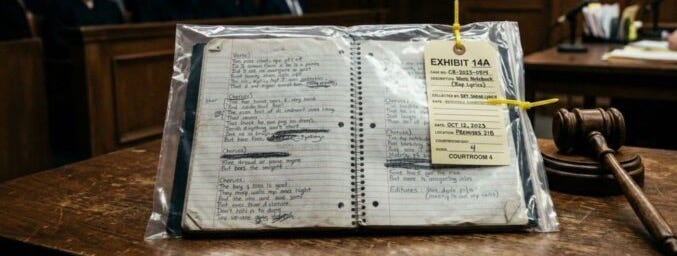
In March 2026, Travis Scott, Killer Mike, T.I., Young Thug, Fat Joe, and a coalition of music scholars and arts organizations filed amicus briefs urging the Court to take the case. The briefs argue that rap lyrics are a fictional form with established conventions of persona and bravado, and that their use in capital proceedings — particularly before predominantly white juries — activates racial bias rather than illuminating fact. Scott’s filing, led by attorney Alex Spiro, invokes the First Amendment’s protection of creative expression. Killer Mike’s brief connects to the 2019 “Hip-Hop Brief” he helped organize in Commonwealth v. Knox, which brought artists including Meek Mill and Chance the Rapper before the Court to contextualize the genre’s conventions. Source
The question the briefs put forward is one American courts have never fully settled: whether fictional violence, written in an art form created largely by Black Americans, can be used as evidence of who a person is. The same standard is never applied to horror novelists, crime writers, or method actors who portray the same darkness for predominantly white audiences.
Immigration as a Censorship Tool
In May 2025, Secretary of State Marco Rubio announced a visa restriction policy targeting individuals deemed “complicit in censoring Americans.” By December, the State Department had instructed consular officers to screen visa applicants — particularly H-1B holders — for work in fields including misinformation research, fact-checking, content moderation, and trust and safety. The mechanism is immigration enforcement. The effect is a chilling silence on American campuses and in research institutions.
In March 2026, Columbia University’s Knight First Amendment Institute and the nonprofit Protect Democracy filed suit on behalf of the Coalition for Independent Technology Research (CITR), challenging the policy as unconstitutional viewpoint discrimination. The lawsuit names Rubio, Attorney General Pam Bondi, and Homeland Security Secretary Kristi Noem as defendants. Among those already affected: Imran Ahmed, who leads the Center for Countering Digital Hate, and Clare Melford, executive director of the Global Disinformation Index — both had visas revoked or restricted.
The documented effect on these researchers is stark. An adjunct professor studying online harms to children has left the country. A content moderation expert with permanent resident status has quietly shifted their research to “more politically neutral” topics and stopped traveling internationally. A professor who studies media and American politics has stopped writing op-eds and canceled public events for a book on disinformation — worried a visa denial is the price of visibility.
The State Department’s position is blunt: “A visa is a privilege, not a right.” What goes unaddressed is that the reason for denial is the content of someone’s work. This is precisely what the First Amendment prohibits the government from doing. The administration has effectively created a category of protected speech that can cost a noncitizen their ability to remain in the United States.
First Grader Drawing Became a First Amendment Case
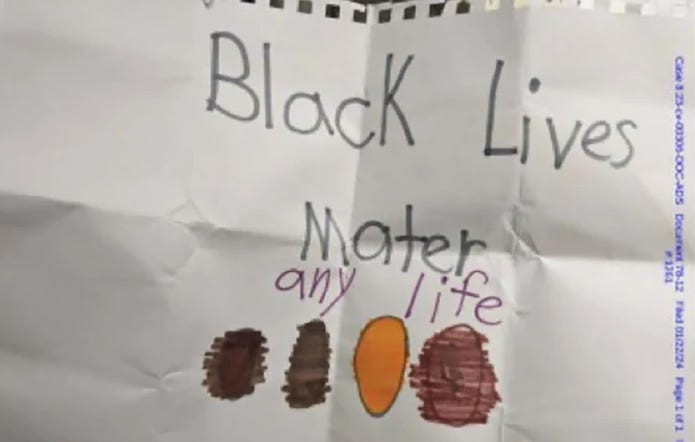
In 2021, a six-year-old White student named B.B. at Viejo Elementary in Mission Viejo, California, made a drawing after her class read about Martin Luther King Jr. Four oval shapes in different skin tones — she said it was her friends holding hands. She wrote “Black Lives Mater” (first-grade spelling), then added “any life,” and gave it to a Black classmate.
The Black classmate’s parent complained to the principal, who made B.B. apologize, banned him from giving drawings to classmates, and excluded him from recess for two weeks.
Her family sued, and a lower court ruled in favor of the school district. Last week, a 9th Circuit three-judge panel reversed that, sending the case back down — and in doing so, made a ruling that’s bigger than one child’s drawing: elementary school students have First Amendment rights. Courts have long applied the 1969 Tinker v. Des Moines standard to student speech (schools can restrict expression only when it causes “substantial disruption” to the learning environment), but it had never been squarely applied at the elementary level. This panel said it applies — with age as a relevant factor — and that the school bears the burden of justifying its restrictions.
What makes this case strange and worth sitting with: the school’s response managed to turn an act of six-year-old solidarity into both a censorship incident and, in the principal’s framing, a racial provocation. The White child who wrote “Black Lives Matter” got punished for racism. The case isn’t over — it goes back to district court — but the constitutional principle just got extended to the youngest students in the system. Source
The Fate of the First Amendment
In her Substack, Former U.S. Attorney Joyce Vance uses two recent press freedom incidents to argue that the First Amendment is being quietly dismantled, one “petty” restriction at a time.
On March 11, 2026, the Pentagon barred press photographers from Defense Secretary Pete Hegseth's briefings on the ongoing war in Iran — not for any security reason, but because his staff objected to published photos of him that they considered unflattering. The move drew immediate condemnation from press freedom advocates as a textbook example of image management masquerading as policy. The ban continues a pattern: earlier, the White House excluded the Associated Press from press pool events after the AP declined to adopt the administration's preferred term "Gulf of America" for the Gulf of Mexico. Taken together, these restrictions represent a shift from traditional press access norms — where credentialed journalists and photographers cover government officials as a matter of public record — toward a model in which access is treated as a privilege contingent on favorable coverage.
The Pentagon has not offered a formal justification beyond staff displeasure with the images, which themselves were taken at official government events.
These actions avoid formal censorship while achieving its practical effect — controlling the image of power by controlling who gets close enough to see it. That’s Vance’s point. The First Amendment is being eroded, not through dramatic repeal, but through incremental exclusions that each get waved off as minor prerogatives of executive power — until the press can only cover what it’s permitted to see, and the distinction between a free press and a managed one disappears. This is what the slow death of press freedom looks like.
“King of the World”
The guerrilla art collective calling itself The Secret Handshake has placed its third unauthorized sculpture on the National Mall — a gold-colored piece titled King of the World depicting Donald Trump and Jeffrey Epstein embracing on a recreation of the Titanic‘s bow, posed in the iconic arms-wide scene from James Cameron’s film.
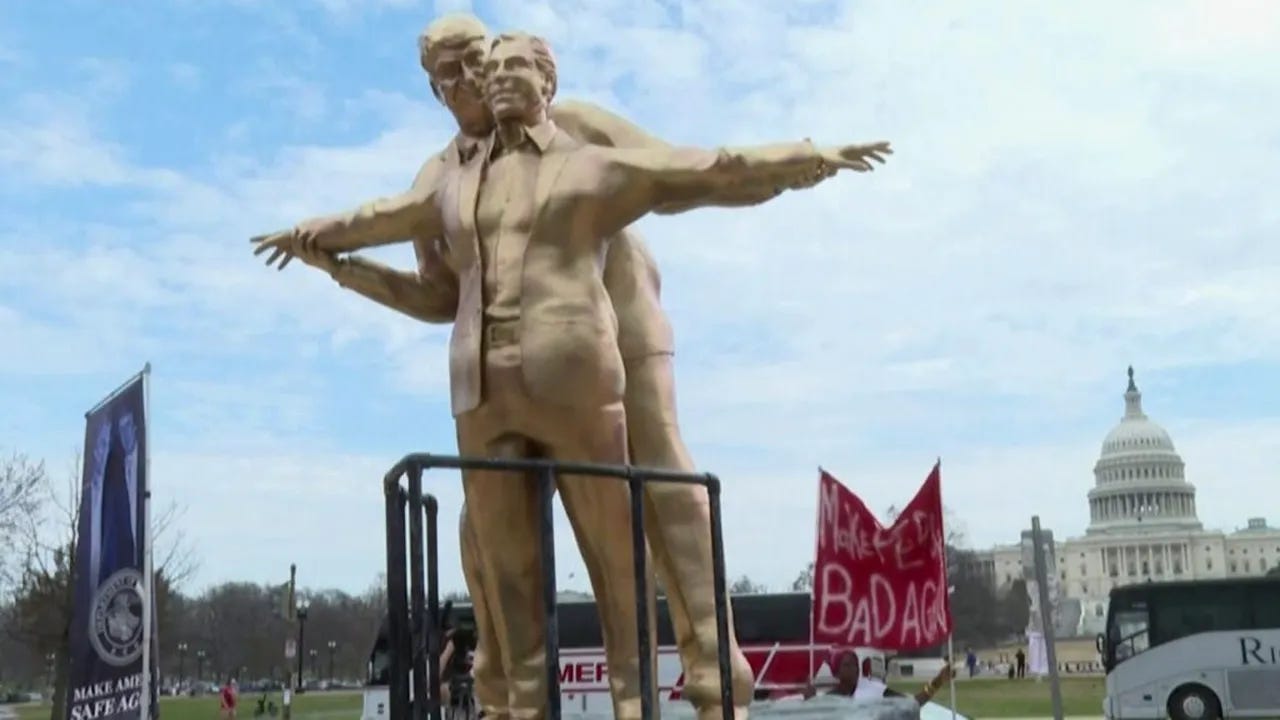
It’s the latest in a series: the group previously installed a massive replica of Trump’s handwritten birthday note from to Epstein, and before that a bronze sculpture called Best Friends Forever showing the two holding hands. The collective said in a statement that 2026 has been “a banner year for President Trump” — delivered with obvious irony.
The anonymity of The Secret Handshake is itself part of a tradition. Guerrilla public art, from Banksy's stenciled walls to the inflatable "Baby Trump” balloons, has long operated in the space between protected speech and trespass, where the legal exposure of signing your name could silence the work before it lands. The First Amendment protects political expression, but not unauthorized installation on federal property. The risk is part of the message, and anonymity is what makes the risk sustainable. There's a long lineage from the unsigned pamphlets of the Revolutionary era to ACT UP's public interventions in the AIDS crisis of movements using unsigned, unsanctioned art to say what permitted channels won't carry. The Supreme Court has repeatedly affirmed the right to anonymous political speech.
DOGE, the NEH, and the First Amendment
The deposition videos were posted publicly on YouTube. Six hours of testimony from Justin Fox, a former investment banker, and tech entrepreneur, Nathan Cavanaugh, who joined DOGE and helped dismantle the National Endowment for the Humanities. They’ve been making the rounds this week, and if you haven’t watched them, the short clips circulating barely capture the full picture. What the full record reveals, now part of a motion for summary judgment filed March 6 in the Southern District of New York, is one of the more consequential First Amendment cases currently moving through the courts.
The plaintiffs are the American Council of Learned Societies, the American Historical Association, and the Modern Language Association — joined by the Authors Guild and a coalition of individual scholars. They filed originally in May 2025 after DOGE, operating through NEH acting chair Michael McDonald, cancelled grants representing hundreds of millions of dollars of congressionally appropriated funds without statutory authority. The motion for summary judgment, filed last week, presses three claims: First Amendment violations, Equal Protection violations under the Fifth Amendment, and separation of powers — DOGE executed the terminations, not the NEH chair, and without Congressional approval. American Historical Association
DOGE workers fed grant application project descriptions into ChatGPT, asking it to decide if the projects were “DEI,” then entered ChatGPT’s responses into a spreadsheet compiling all NEH grants, including their “DEI rationale” and “Yes/No DEI?” replies. This ChatGPT-generated list was used in place of the list created by NEH staffers. ACLS
Justin Fox also created his own “Detection List” of identity-based traits, with separate categories for “Craziest Grants” and “Other Bad Grants,” before running the databases through the generative AI software. The search terms he scanned for included “Black,” “homosexual,” “LGBTQ,” and “Tribal” — but not “white” or “Caucasian.” The asymmetry isn’t incidental; it’s the constitutional crux. DOGE staffers violated the Federal Equal Protection Clause of the 5th Amendment by flagging grant descriptions as “DEI” solely because they included “BIPOC,” “homosexual,” “LGBTQ,” and “Tribal,” among other terms. American Historical Association
What got caught in the net? A documentary about Jewish women’s slave labor during the Holocaust; an archival project on the lives of Italian Americans; a project to digitize photograph collections of Appalachian residents; and multiple projects to preserve endangered Native American languages and cultures. DOGE staffers also flagged grants that NEH leaders concede had no connection to DEI, including grants awarded for collections management after a natural disaster, preservation training, and improving HVAC systems. A joint effort by the University of Oregon and the University of Nebraska-Lincoln to help digitize newspapers was canceled because digital newspapers are “more accessible,” and therefore, ChatGPT determined, more inclusive.
The government’s power to fund or defund speech through grants is constitutionally constrained. The doctrine of unconstitutional conditions holds that the government cannot use funding as a lever to punish or suppress particular viewpoints. When grants are terminated not because of fiscal need or programmatic failure but because their subject matter includes certain identities or perspectives, that’s viewpoint-based discrimination — one of the most clearly prohibited categories under the First Amendment.
The plaintiffs’ brief explicitly frames this as a First Amendment case. Fox and his DOGE colleague “entirely controlled the process of selecting grants to terminate and executing the terminations — their approach was top-down, viewpoint- and race-based, and indifferent to the views of NEH leadership or the ordinary processes of grant administration.”
There’s also the question of who actually had legal authority here. The acting chair, Michael McDonald, ceded his authority over this process to DOGE, writing to Fox, “as you’ve made clear, it’s your decision on whether to discontinue funding any of the projects on this list.” McDonald, in his own deposition, said he hadn’t known DOGE used ChatGPT — and that he wouldn’t have considered Holocaust-related grants to be DEI or wasteful.
Meanwhile, key members of the DOGE team bypassed authorized record preservation requirements and violated the Federal Records Act by conducting official government business on Signal, a messaging application unauthorized for federal employees, intentionally set to automatically delete messages. American Historical Association
The case has one more dimension worth noting. Even as DOGE was using an AI chatbot to cancel grants focused on Jewish culture as “DEI,” after the termination of previously awarded grants, McDonald asked an NEH staff member to solicit the Tikvah Fund’s application for a single-source award; the NEH ultimately granted it $10 million — its largest-ever single grant. Tikvah is a politically conservative Jewish cultural organization. The contrast — Holocaust scholarship flagged as DEI and cut, while a politically aligned Jewish organization received a record grant, makes the viewpoint discrimination explicit. PR Newswire
The motion for summary judgment is now before Judge Mary Kay Vyskocil in the Southern District of New York. The outcome will matter well beyond the humanities.
Jefferson and the Treaty of Tripoli
When Tennessee Representative Andy Ogles posted that “Muslims don’t belong in American society” and “Pluralism is a lie,” he wasn’t just expressing a fringe opinion. He was directly contradicting the founding documents he claims to revere, not as a matter of interpretation, but in their explicit, on-the-record language.
Thomas Jefferson, when drafting what became the template for the First Amendment’s religion clauses, specifically celebrated that Virginia’s legislature rejected an attempt to insert “Jesus Christ” into his Statute for Religious Freedom. He recorded in his 1821 autobiography that this made the statute’s protection universal — written “to comprehend, within the mantle of its protection, the Jew and the Gentile, the Christian and the Muslim, the Hindu, and infidel of every denomination.” He specifically opposed religious references in law because they implied a restriction of liberty to those professing Christianity only. This was one of three accomplishments Jefferson instructed be carved on his tombstone. Maydan
The documentary record goes further. In 1797, the Senate ratified the Treaty of Tripoli — unanimously, without debate — which formally declared that the U.S. government “has in itself no character of enmity against the laws, religion, or tranquility of Mussulmen,” and that no pretext arising from religious opinions would ever interrupt harmony between the two nations. George Washington wrote that workers for Mount Vernon were welcome whether “Mahometans, Jews or Christians of any Sect, or Atheists.” Richard Henry Lee moved in Congress in 1776 that “True freedom embraces the Muslim and the Hindu as well as the Christian religion.” Wikipedia
Speaker Johnson’s response — that Ogles and Fine reflect “popular sentiment” about Sharia law — deploys a rhetorical sleight of hand worth naming: it reframes constitutional exclusion as cultural concern. But the Free Exercise Clause doesn’t protect the religion that anyone personally finds acceptable. It protects religion.
CAIR’s national deputy director Edward Mitchell put the double standard plainly: had any member of Congress declared that Jews don’t belong in America, the response would have been immediate condemnation and censure. That Ogles has faced none is not a legal technicality, it’s a measure of how selectively we’re currently willing to apply the Constitution’s promises.
The founders used Muslims as their explicit test case for religious universalism — the outer limit that would prove the principle genuine. Jefferson and his contemporaries thought about Muslims as the “imaginary outer limit for a uniquely American pluralism, a universal ambit of citizenship.” Virginia
Acknowledgement
We are always grateful for the encouragement and suggestions of our colleagues and peers.
NEXT STEPS: TAKE ACTION
First Amendment Friday
F.A.C.T. invites all cultural institutions, artists, and activists to post First Amendment stories, graphics, calls to action, and advice to their audience every Friday. Join our campaign by signing up here. Feel free to use our digital assets here.
Public Practice
We are asking cultural venues in New York City (and across the USA) to prominently place our First Amendment poster in their public areas. Sign up to get your copy. We are also asking performance venues to share our curtain speech (or create your own).